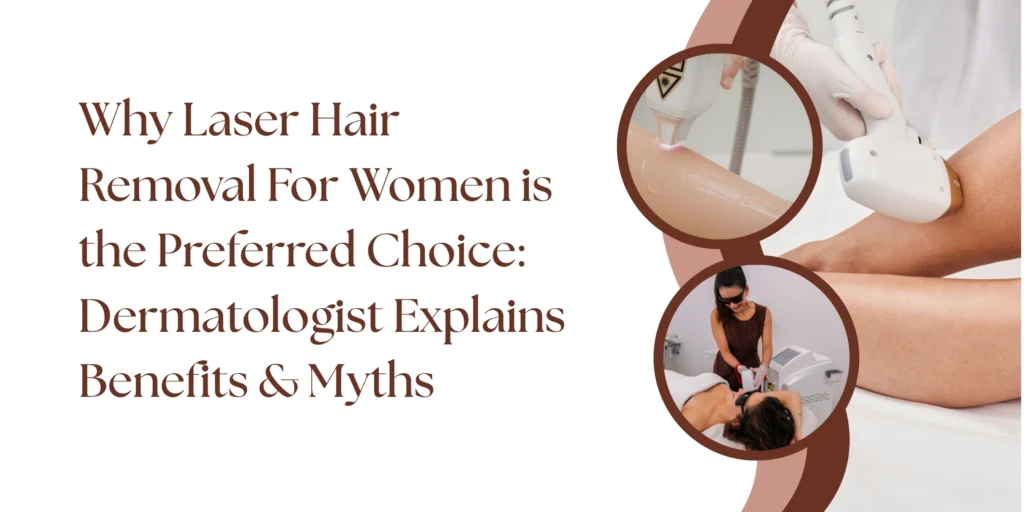
Laser hair removal for women has become the preferred alternative to waxing, threading, and shaving because it addresses the problem at the follicle, not just the surface. It delivers 70–90% long-term hair reduction, works safely on all Indian skin tones, and is clinically validated even for women with PCOS. At AK Dermacare in West Delhi, the PrimeLase diode laser system with triple wavelengths, and Crystal Freeze cooling procedure makes every session precise, fast, and far more comfortable than conventional hair removal. Most women complete the process in 6–8 sessions.
Key Takeaways
- Is laser hair removal safe for women? Yes, when performed by a qualified dermatologist using medical-grade technology like PrimeLase, it is safe for all skin tones. The laser targets only hair follicles and does not affect hormones, fertility, or internal organs.
- Can women with PCOS get laser hair removal? Yes. Clinical evidence shows 95% patient satisfaction and 50–79% hair reduction in PCOS patients after treatment.
- How many sessions are needed? Most women need 6–8 sessions. Hormonal conditions may need more.
- Does it permanently remove facial hair? Laser delivers 70–90% long-term reduction. Hormonally driven unwanted facial hair in women may need periodic maintenance.
You have been threading your upper lip since your teens. Waxing your arms every three weeks. Booking appointments that eat into your schedule, only to be back at the salon a fortnight later. Every method delivers a few days of smooth skin followed by stubble, ingrown hairs, and the same routine starting over.
What if you could break that cycle for good?
It is now possible with laser hair removal for women. And yet many women hold back, because of unanswered questions about safety, concerns about darker Indian skin, worries about PCOS, or myths passed around with far more confidence than they deserve. This blog answers all of it directly, so you can make a genuinely informed decision.
At AK Dermacare, we believe transparency builds trust. Here is what clinical evidence and dermatologist experience actually tell us , including the nuances that matter.
Why Laser Hair Removal Has Become the Preferred Choice For Women
The shift toward laser hair removal for women isn’t a trend. It reflects a simple cost-benefit reality once women understand what the technology delivers.
Threading, waxing, and shaving are all surface solutions. They remove hair temporarily and come with their own set of problems, post-wax pigmentation on Indian skin, ingrown hairs from shaving, and the relentless frequency of it all. Most women estimate they spend 50–100+ hours annually on conventional hair removal routines. Laser hair removal compresses that into a finite course of sessions with results that genuinely last.
By destroying the follicle at the root through a process called selective photothermolysis, laser hair removal for women delivers progressive, long-term reduction across sessions — typically 70–90% fewer hairs after a complete course. Any residual regrowth comes back finer, lighter, and far slower than before.
| Hair Removal Method | Frequency Required | Ingrown Hair Risk | Long-Term Cost | Lasting Results |
| Threading | Every 2–3 weeks | Moderate | High | None |
| Waxing | Every 3–4 weeks | High | Very high | None |
| Shaving | Every 2–3 days | High | Moderate | None |
| Laser (PrimeLase at AK Dermacare) | 6–8 sessions total | None | Low | 70–90% reduction |
The Science Behind Laser Hair Removal For Women: A Dermatologist Explains
Understanding how laser hair removal works helps explain why it outperforms every conventional method for long-term results. When a laser beam is directed at the skin, its light energy is absorbed by melanin, the pigment in the hair shaft and converted into heat. That heat travels down to the follicle root and destroys it, while the surrounding skin remains unaffected. This is selective photothermolysis: targeted energy that affects only what it is calibrated to target.
Because hair grows in three phases: anagen (active growth), catagen (transition), and telogen (resting), the laser is only effective on follicles currently in the anagen phase. This is precisely why multiple sessions are needed: each session catches a new batch of follicles as they cycle into active growth.
At AK Dermacare in West Delhi, laser hair removal treatment uses the PrimeLase diode laser. With 4800 W peak power, triple wavelengths (755 nm, 810 nm, and 1060 nm), and built-in Crystal Freeze cooling at +5°C, PrimeLasetargets hair across all skin tones and textures — including the coarse, dark follicles common in Indian women, while keeping the session comfortable from start to finish.
Key Benefits of Laser Hair Removal For Women: What Dermatologists Observe
Long-Term Hair Reduction: Most women achieve 70–90% reduction after completing a full course. Unlike waxing or threading, the improvement is cumulative — each session builds on the last, and results do not reset.
Reduction in Skin Problems: Ingrown hairs, razor bumps, and post-threading pigmentation on the upper lip and chin — common complaints among Indian women — are eliminated when you stop repeated conventional hair removal and switch to laser.
Precision on Delicate Areas: PrimeLase‘s calibrated beam treats small facial zones — the upper lip, chin, sideburns, and jawline — with precision, without affecting the surrounding skin.
Suitable for All Indian Skin Tones: The 1060 nm wavelength in PrimeLase bypasses surface melanin and reaches deep follicles without excess heat absorption at the skin surface, making it safe and effective for darker Fitzpatrick skin types (IV–VI) that older laser systems handled poorly.
Faster Sessions: PrimeLase‘s large spot size and high repetition rate mean even full-body treatments are completed faster than with older diode systems — a practical benefit for busy women.
Is Laser Hair Removal Safe For Women? What the Evidence Confirms
This is the most common question dermatologists hear. The clinical answer is yes — with the right technology and the right provider.
No Effect on Hormones or Fertility: The laser targets follicles in the superficial layers of the skin. It does not penetrate deep enough to affect the uterus, ovaries, or hormonal function. This is a persistent myth with no clinical basis.
Safe for Darker Indian Skin Tones: Peer-reviewed studies on diode laser hair removal in darker skin types (Fitzpatrick III–VI) confirm high safety and efficacy when parameters are correctly calibrated. PrimeLase‘s Crystal Freeze cooling and wavelength selection specifically address the risk of burns or post-procedure pigmentation that older machines posed for darker skin.
Temporary, Mild Side Effects Only: Redness or mild warmth after a session are the most common responses — both typically resolve within a few hours. Serious adverse effects are rare and almost always linked to incorrect devices, undertrained operators, or unqualified settings.
Women who should consult their dermatologist before starting:
- Pregnant or breastfeeding women (insufficient safety data exists, not due to proven harm)
- Those with active skin infections or open wounds in the treatment area
- Women on photosensitizing medications
- Those with uncontrolled hormonal conditions, until medically managed
A pre-treatment consultation and patch test — standard practice at AK Dermacare — screens for all contraindications before the first session.
Laser Hair Removal For Women with PCOS: What Dermatologists Say
Women with PCOS experience elevated androgen levels that stimulate excess hair growth — known as hirsutism — on the face, chin, neck, and chest. Threading and waxing simply cannot keep pace with this growth. Laser hair removal offers what conventional methods never can: progressive, long-term reduction at the follicle level.
Clinical studies confirm this clearly. PCOS patients achieve 50–79% reduction in hair growth six months after laser treatment, with 95% patient satisfaction reported despite the ongoing hormonal component. More sessions are typically needed — often 8–10 or more — because hormones continue to stimulate new follicles over time. Periodic maintenance every 6–12 months addresses new growth.
Combining laser hair removal with medically prescribed hormonal therapy delivers the best and most sustained results for women with PCOS. PrimeLase‘s high peak power and triple wavelength flexibility make it particularly effective for the coarse, deep-rooted facial hair typical of PCOS-related hirsutism on Indian skin. At AK Dermacare, PCOS patients are counselled on realistic expectations and given a customized session plan that accounts for their hormonal profile.
Busting the Most Common Myths About Laser Hair Removal For Women
| Myth | What Dermatologists Actually Say |
| Laser affects fertility and hormones | Laser hair removal targets follicles in the superficial skin only. It has zero impact on hormones, fertility, or internal organs |
| It only works on fair skin with dark hair | PrimeLase‘s triple wavelengths treat all Indian skin tones safely with correctly calibrated settings |
| Laser makes facial hair grow back thicker | Properly administered laser hair removal reduces density and thickness progressively. Paradoxical thickening is rare and device-dependent, not a property of diode laser technology |
| One session is enough for permanent results | Hair grows in phases — 6–8 sessions are needed to treat all follicles as they cycle through active growth |
| Laser hair removal is unbearably painful | PrimeLase‘s Crystal Freeze cooling makes sessions far more comfortable than waxing, including on sensitive facial areas |
Why Choose AK Dermacare for Laser Hair Removal Treatment in West Delhi
For women seeking laser hair removal treatment in West Delhi, AK Dermacare combines dermatologist expertise with the PrimeLase platform to deliver personalized, safe, and clinically effective outcomes.
Dermatologist-Led Treatment: All sessions are performed or supervised by qualified dermatologists experienced in Indian skin types and hormonally influenced hair patterns in women — including PCOS-related unwanted facial hair in women.
PrimeLase Technology: 4,800 W peak power, triple wavelengths, and Crystal Freeze cooling — delivering faster sessions, better outcomes, and greater comfort than older diode systems.
Personalized Protocols: Treatment plans are customized to your skin type, hair texture, treatment area, hormonal history, and medical background — not a one-size-fits-all approach.
Pre-Treatment Safety Evaluation: Every patient receives a full consultation and patch test before starting, confirming suitability and setting honest expectations.
Ongoing Monitoring: Follow-ups are scheduled throughout your course to track progress, adjust intervals where needed, and ensure results continue to improve.
Final Thoughts
Laser hair removal for women is not a shortcut or a luxury, it is a clinically supported, dermatologist-recommended solution for long-term freedom from unwanted facial hair in women, PCOS-driven hirsutism, and the relentless cycle of conventional hair removal. The technology exists. The evidence is solid. The only variable that matters is where you have it done and by whom.
At AK Dermacare in West Delhi, our dermatologists combine clinical expertise, PrimeLase technology, and genuinely personalized care to ensure your laser hair removal journey is safe, effective, and built around your specific needs — not a generic protocol. Because results you can trust start with a dermatologist you can trust.
Frequently Asked Questions (FAQs)
1. Can laser remove facial hair permanently in women?
Laser hair removal delivers long-term reduction — typically 70–90% fewer hairs after a full course. Unwanted facial hair in women with a hormonal component may need periodic maintenance, but visible hair is dramatically and lastingly reduced after completing treatment.
2. What is the cost of laser hair removal for women?
Cost depends on the treatment area, number of sessions required, technology used, and clinic. At AK Dermacare, laser hair removal treatment in West Delhi is offered in customized packages. Book a consultation for a personalized quote based on your area and specific requirements.
3. Can women with PCOS do laser hair removal?
Yes. Women with PCOS can safely undergo laser hair removal for women with medical clearance. More sessions are typically needed due to ongoing hormonal stimulation. Combining treatment with prescribed hormonal therapy delivers the most sustained long-term outcomes.
4. How many sessions are needed for women?
Most women need 6–8 sessions spaced 4–6 weeks apart. Unwanted facial hair in women with hormonal causes or coarser body hair may need 8–10 sessions, with maintenance every 6–12 months.
5. Is laser hair removal safe for women with darker Indian skin tones?
Yes. PrimeLase‘s triple wavelength system and dermatologist-controlled settings make laser hair removal safe for darker Indian skin types. Crystal Freeze cooling and precise wavelength selection minimize risk of burns or pigmentation changes.6. Does PrimeLase hurt? How does it compare to waxing?
Most women describe PrimeLase sessions as significantly more comfortable than waxing. Crystal Freeze cooling maintains a comfortable skin surface temperature throughout — even on sensitive areas like the upper lip and bikini line.