
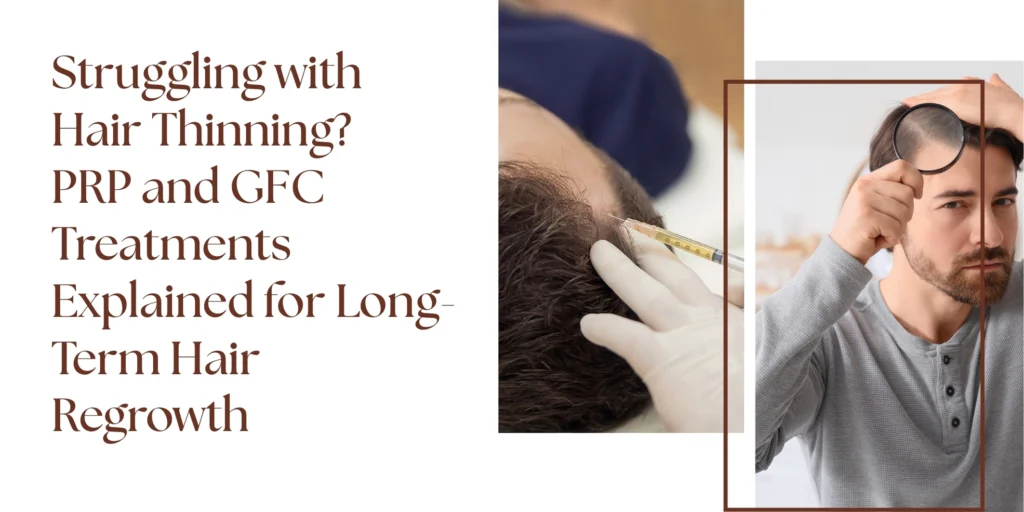
PRP treatment for hair loss and GFC treatment for hair loss are two of the most clinically effective, non-surgical options available for hair thinning , both using growth factors derived from the patient’s own blood to stimulate dormant follicles, slow shedding, and promote new hair growth. GFC (Growth Factor Concentrate) is a newer, more refined evolution of PRP with higher growth factor concentration and no red blood cells , delivering stronger follicle stimulation with less scalp discomfort. At AK Dermacare in West Delhi, Dr. Parul Garg diagnoses the root cause of hair thinning before recommending either treatment , because the right protocol depends entirely on what is driving the loss, not just how much hair has been lost.
Key Takeaways
- What is PRP treatment for hair loss? Platelet-Rich Plasma therapy involves injecting concentrated platelets from the patient’s own blood into the scalp to deliver growth factors that stimulate follicle activity and slow hair shedding.
- What is GFC treatment for hair loss? Growth Factor Concentrate is a refined, next-generation alternative to PRP , with a higher concentration of active growth factors, no red blood cells, and a more targeted follicle stimulation effect.
- Which is better , PRP or GFC? GFC delivers higher growth factor concentrations and is generally better tolerated, making it the preferred choice for patients seeking stronger results. PRP remains clinically effective and widely validated.
- How many sessions are needed? Both treatments typically require an initial course of 4–6 sessions, followed by maintenance every 3–6 months for sustained results.
Introduction
Hair thinning is one of those concerns that most people quietly manage for longer than they should before seeking help. A wider parting. More hair in the shower drain. A scalp that is increasingly visible under certain lighting. The instinct is often to try a new shampoo, add a supplement, or wait and see. By the time most patients consult a dermatologist, the thinning has been progressing , and in some cases accelerating , for months or years.
The most important thing Dr. Parul Garg tells patients at their first hair loss consultation at AK Dermacare is this: the earlier you address hair thinning, the better the outcome. Follicles that are weakened and miniaturizing respond to treatment far better than follicles that have already closed. Waiting for the problem to become undeniable is the single most common reason hair thinning treatment delivers less than it could.
PRP treatment for hair loss and GFC treatment for hair loss have transformed what is possible with non-surgical hair regrowth , moving the conversation well beyond the shampoo aisle and into genuine, clinically measurable follicle regeneration. This blog explains both clearly: how they work, what they deliver, how they differ, and how to know which is right for you.
Understanding Hair Thinning: Why Diagnosis Comes Before Treatment
Before any hair thinning treatment begins at AK Dermacare, Dr. Parul Garg invests in understanding what is driving the loss. This is not a formality , it is the difference between a treatment plan that works and one that addresses the wrong problem.
Hair thinning has multiple possible causes, and many patients have more than one operating simultaneously:
Androgenetic Alopecia (AGA): The most common cause , genetic sensitivity to DHT (dihydrotestosterone) that miniaturizes follicles progressively over time. Presents as a receding hairline in men and diffuse thinning at the crown and parting in women.
Telogen Effluvium: A diffuse shedding triggered by a physiological shock , nutritional deficiency (iron, ferritin, vitamin D, zinc), illness, surgery, extreme stress, significant weight loss, or hormonal shift (postpartum, thyroid change). Hair enters the resting phase prematurely and sheds in large volumes.
PCOS-Related Hair Thinning: Elevated androgens in women with PCOS drive both excess body hair and scalp hair thinning simultaneously , the same hormonal imbalance producing opposite effects in different locations.
Alopecia Areata: An autoimmune condition where the immune system attacks hair follicles, producing patchy, well-defined areas of sudden hair loss.
Nutritional Deficiencies: Chronic low ferritin is one of the most underdiagnosed drivers of diffuse hair thinning in Indian women , often missed because standard blood tests check serum iron rather than ferritin specifically.
At AK Dermacare, diagnosis includes trichoscopy (non-invasive scalp imaging that reveals follicle miniaturization, scalp condition, and hair cycle status) and targeted blood investigations where indicated. Only once the cause is confirmed does hair thinning treatment begin , because PRP treatment for hair loss and GFC treatment for hair loss work best when the underlying driver is concurrently addressed alongside them.
What Is PRP Treatment for Hair Loss?
PRP treatment for hair loss , Platelet-Rich Plasma therapy , is a medical procedure in which a small volume of the patient’s own blood is drawn, processed in a centrifuge to concentrate the platelet-rich plasma, and then injected directly into the areas of the scalp experiencing thinning or loss.
Platelets contain alpha granules packed with growth factors , including PDGF (Platelet-Derived Growth Factor), VEGF (Vascular Endothelial Growth Factor), EGF (Epidermal Growth Factor), and IGF (Insulin-like Growth Factor). When concentrated PRP is injected into the scalp, these growth factors:
- Stimulate dormant hair follicles to re-enter the active growth (anagen) phase
- Increase blood supply to the follicle base, improving nutrient and oxygen delivery
- Reduce follicle miniaturization driven by DHT in androgenetic alopecia
- Extend the duration of the anagen phase, resulting in longer, thicker, more robust hair growth
What the evidence shows: Multiple peer-reviewed clinical studies confirm that PRP treatment for hair losssignificantly increases hair density, hair shaft thickness, and the anagen-to-telogen ratio in patients with androgenetic alopecia and telogen effluvium. Results are measurable , not just patient-reported.
The procedure: Blood is drawn (typically 10–20 ml), centrifuged for 8–15 minutes to separate plasma from red blood cells and white blood cells, and the resulting PRP is injected into the scalp using fine needles. A topical numbing cream is applied beforehand to minimize discomfort. The session takes approximately 45–60 minutes. There is no downtime.
What Is GFC Treatment for Hair Loss?
GFC treatment for hair loss , Growth Factor Concentrate , is a newer, more refined evolution of PRP that addresses some of the limitations of standard PRP by producing a significantly purer, more potent growth factor preparation.
In standard PRP, the centrifuged preparation still contains red blood cells and white blood cells alongside platelets. Red blood cells contribute no growth factor activity and can cause local inflammation when injected. White blood cells, depending on the PRP system used, can have pro-inflammatory effects that counteract the regenerative intent of the treatment.
GFC uses a specialized processing system with activator tubes that selectively release and concentrate only the growth factors from platelets , without the red blood cell and white blood cell fraction. The result is a purer preparation with significantly higher growth factor concentration, lower inflammatory potential, and a more comfortable injection experience.
Key differences in the preparation:
| Feature | PRP | GFC |
| Growth factor concentration | Moderate , depends on centrifuge system | High , selectively concentrated |
| Red blood cell content | Present | Absent |
| White blood cell content | Variable | Minimal to absent |
| Scalp discomfort post-injection | Moderate | Mild , lower inflammatory response |
| Preparation time | 15–20 minutes | 20–30 minutes |
| Clinical evidence | Extensive, long-established | Growing, strong recent evidence |
PRP vs GFC Which Is Better: What Dermatologists Observe
The PRP vs GFC which is better question is the one patients ask most frequently once they understand both options. The honest answer requires nuance , because both are effective, and the right choice depends on the individual patient.
Where GFC has an advantage:
- Higher growth factor concentration means stronger follicle stimulation per session , particularly relevant for patients with moderate-to-advanced thinning where follicles need more intensive reactivation
- The absence of red blood cells eliminates the localized scalp inflammation and soreness that some PRP patients experience, making sessions more comfortable and the post-treatment scalp reaction milder
- For patients who have previously undergone PRP with partial results, GFC often delivers the additional response that motivates a more complete improvement
- GFC is increasingly the preferred choice for women with PCOS-related or hormonal hair thinning, where follicle miniaturization tends to be more diffuse and requires consistent, concentrated stimulation
Where PRP remains the right choice:
- PRP has decades of peer-reviewed clinical evidence across diverse populations , the evidence base is broader and more established than GFC’s, which is newer
- For patients with early-stage thinning, PRP delivers very satisfactory results and remains the globally recommended first-line biological hair thinning treatment by most dermatological associations
- Cost difference between PRP and GFC is a practical consideration for patients planning an extended course
Dr. Parul Garg’s clinical approach at AK Dermacare: Both treatments are offered, and the recommendation is made after a full trichoscopic and clinical assessment , based on the severity of thinning, the likely cause, previous treatments tried, and the patient’s scalp response profile. Neither is universally superior in every case , the best treatment is the one matched to the right patient.
Hair Thinning Treatment at AK Dermacare: The Complete Protocol
At AK Dermacare, PRP treatment for hair loss and GFC treatment for hair loss are never administered in isolation. Dr. Parul Garg’s hair thinning protocols integrate biological therapy with concurrent medical management for the most complete possible response:
Trichoscopy-Based Diagnosis: Every new patient receives a trichoscopic scalp assessment and blood investigations before treatment begins , identifying the hair loss type, assessing follicle status, and ruling out nutritional or hormonal drivers that need concurrent treatment.
Medical Adjunct Therapy: Where indicated, PRP or GFC is combined with topical minoxidil, prescription oral treatments, or hormonal management (for PCOS-related thinning) , because biological injections alone cannot overcome a continuing hormonal or nutritional driver.
Nutritional Correction: Ferritin, vitamin D, zinc, and B12 deficiencies are identified and corrected in parallel , because PRP and GFC deliver significantly better results when the nutritional environment supports follicle regeneration.
Scalp Health Management: Where seborrheic dermatitis, dandruff, or scalp inflammation is present, targeted scalp treatment is initiated before or alongside PRP/GFC , because an inflamed scalp environment impairs follicle response to treatment.
Progress Monitoring: Follow-up trichoscopy and photographic documentation at the midpoint and end of the course allow Dr. Parul Garg to measure objective improvement, adjust session frequency, and determine the maintenance interval that sustains results most effectively for each patient.
Myths vs. Facts About PRP and GFC Treatment for Hair Loss
| Myth | What Dermatologists Actually Say |
| PRP and GFC work instantly | Both treatments produce gradual, progressive improvement over 3–6 months. Reduced shedding is the first sign , visible density improvement develops across the course |
| They work for all types of hair loss | PRP treatment for hair loss and GFC treatment for hair loss are most effective for androgenetic alopecia and telogen effluvium , other causes require different primary treatments |
| One course is enough permanently | Maintenance sessions every 3–6 months are needed to sustain results , follicles require ongoing growth factor support to resist miniaturization |
| GFC is always better than PRP | GFC offers higher concentration and better tolerance for many patients, but PRP has a broader evidence base and delivers excellent results for early-stage thinning |
| These treatments are painful | Both are performed under topical anaesthesia. Most patients describe mild pressure and pinching , GFC is generally more comfortable than PRP due to its lower inflammatory content |
Why Choose AK Dermacare for Hair Thinning Treatment
For patients in West Delhi seeking PRP treatment for hair loss or GFC treatment for hair loss, AK Dermacare under Dr. Parul Garg offers a clinically rigorous, diagnosis-first approach that goes well beyond a straightforward injection appointment.
Trichoscopy-Informed Treatment: Every hair thinning consultation at AK Dermacare begins with objective scalp assessment , not a visual estimate. Trichoscopy reveals follicle miniaturization status, scalp condition, and hair cycling data that directly informs which treatment, at what concentration, and at what frequency, is appropriate for each patient.
Both PRP and GFC Available: Dr. Parul Garg offers both treatments and recommends based on clinical assessment , not on which option is more profitable or easier to deliver. The recommendation is always patient-specific.
Integrated Hair Loss Protocol: PRP or GFC is integrated into a complete hair health plan , concurrent medical therapy, nutritional correction, scalp management, and progress monitoring , for the most comprehensive response possible.
Honest Expectations: Dr. Parul Garg sets clear, realistic expectations at every consultation. Hair regrowth treatments require consistency and time. Patients who understand what to expect at each stage of the process complete their courses, see the results, and maintain them effectively.
Final Thoughts
Hair thinning does not have to be a one-way journey. PRP treatment for hair loss and GFC treatment for hair loss represent a genuine clinical advance in non-surgical hair regrowth , using the body’s own regenerative biology to wake up weakened follicles, slow ongoing loss, and rebuild hair density over a structured course of treatment.
The most important factor in the outcome is not which of the two treatments you choose , it is whether you start early, whether the underlying cause is correctly identified and concurrently addressed, and whether you complete the course consistently rather than abandoning it at the point where results are still developing.
At AK Dermacare in West Delhi, Dr. Parul Garg’s approach to hair thinning treatment is built on this foundation: diagnose accurately, treat the cause and the follicle simultaneously, and give the treatment the time and consistency it needs to deliver what the science says it can. If your hairline is changing or your parting is widening, now is the right time , not later.
Frequently Asked Questions (FAQs)
1. Which is better, PRP or GFC for hair regrowth?
Both are effective. GFC treatment for hair loss delivers higher growth factor concentrations, lower inflammatory response, and generally better tolerance , making it the preferred choice for moderate-to-advanced thinning or patients who have had partial results with PRP. PRP treatment for hair loss has a broader, longer-established evidence base and delivers excellent results for early-stage androgenetic alopecia and telogen effluvium. Dr. Parul Garg recommends trichoscopic assessment and individual patient profile at AK Dermacare.
2. How many sessions are needed for PRP?
An initial course of 4–6 sessions spaced 3–4 weeks apart is the standard protocol for PRP treatment for hair loss. Results build progressively across the course, with peak improvement typically visible by month 5–6. Maintenance sessions every 3–6 months thereafter sustain the results and prevent follicle regression.
3. Is GFC treatment safe?
Yes. GFC treatment for hair loss uses only the patient’s own blood components , making allergic reaction or rejection essentially impossible. The refined preparation process eliminates red blood cells and minimizes inflammatory components, making it one of the safest biological hair thinning treatments available. Side effects are minimal , mild scalp tenderness or redness at injection sites resolves within 24 hours.
4. How long does it take to see results after PRP or GFC?
The first noticeable change , reduced shedding , typically occurs within 4–6 weeks of starting treatment. Visible new hair growth begins appearing from month 2–3. Meaningful improvement in hair density becomes clearly apparent from month 4–5. Peak results from the initial course are usually fully visible by month 6. Patience and consistency with the complete course are essential , stopping early is the primary reason for incomplete results.
5. Can PRP or GFC be combined with other hair loss treatments?
Yes , and combining them typically produces better outcomes than either treatment alone. At AK Dermacare, Dr. Parul Garg integrates PRP or GFC treatment for hair loss with topical minoxidil, oral prescription treatments where indicated, nutritional correction, and scalp health management , creating a comprehensive hair thinning treatment protocol that addresses both the follicle and the underlying drivers of loss simultaneously.