
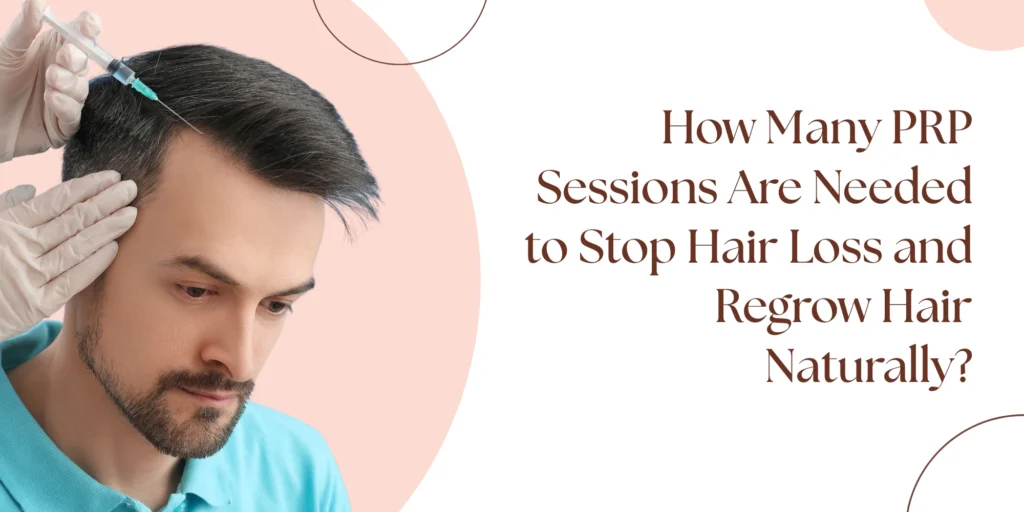
Platelet rich plasma hair treatment is one of the most effective dermatologist-led options for early hair thinning because it supports existing follicles rather than masking the problem at the surface. Most people need 3 to 6 PRP sessions to see visible improvement, with maintenance sessions every few months if they want to preserve the results. At AK Dermacare in West Delhi, PRP is planned according to the cause of hair loss, the stage of thinning, and how much active follicle function is still present. The question is not just how many PRP sessions are needed for hair growth but how early treatment begins and whether the scalp is still capable of responding naturally.
Key Takeaways
How many PRP sessions are needed? Most patients need 3 to 6 initial sessions spaced 4 to 6 weeks apart.
How long does PRP take to regrow hair? Reduced shedding may appear within 4 to 8 weeks, while visible thickening usually takes 3 to 4 sessions.
How often should PRP be done for hair? After the initial course, maintenance is commonly recommended every 3 to 6 months depending on response.
Can PRP permanently stop hair loss? No, not for most patients. PRP can slow hair loss and improve density, but maintenance is usually needed to sustain results.
If you are searching for PRP Hair Treatment in West Delhi, you are probably not looking for a theory lesson. You want to know whether it works, how long it takes, and how many sessions you will actually need before you see a difference in the mirror. That is the real question behind every consultation: how many PRP sessions needed for hair growth and whether the investment is worth it.
PRP, or platelet rich plasma hair treatment, is not a one-time fix. It is a regenerative course that uses your own platelet growth factors to support weakened follicles, reduce shedding, and improve hair thickness over time. It works best when hair loss is caught early, because PRP can stimulate active follicles but cannot create new ones where they are already gone.
At AK Dermacare in West Delhi, PRP treatment for hair regrowth is designed by Dr. Parul Garg based on follicle activity, scalp condition, and the cause of thinning. That matters because the right session count is different for every patient.
How PRP Works for Hair
Platelet rich plasma hair treatment begins with a small blood draw, followed by processing the blood to concentrate the platelets. Those platelets contain growth factors that are injected into the scalp to support follicle health, improve circulation, and encourage thicker hair production.
The process is best understood as follicle support rather than follicle replacement. If the follicles are still alive but miniaturizing, PRP can help them function better. If a bald area has been inactive for a long time, the response is much weaker.
That is why PRP treatment for hair regrowth works best for early thinning, pattern hair loss, and some forms of diffuse shedding. It is not designed to revive completely dead follicles, which is why earlier treatment tends to produce better outcomes.
How Many Sessions You Need
Most people need 3 to 6 PRP sessions to see meaningful improvement. The exact number depends on the severity of hair loss, the response of the scalp, and whether the underlying cause is still active.
- 3 sessions may be enough for very early thinning or maintenance in a good responder.
- 4 sessions is a common minimum for visible improvement in shedding and density.
- 5 to 6 sessions are often needed when thinning is more established or the response is slower.
This is why the answer to how many PRP sessions needed for hair growth cannot be the same for everyone. A patient with recent thinning and active follicles may respond faster than someone with long-standing pattern hair loss. If the cause is hormonal or genetic and still active, PRP may help, but it usually needs to be part of a longer plan.
How Long It Takes to Regrow Hair
One of the most common questions patients ask is how long does PRP take to regrow hair. The honest answer is that it takes patience. PRP is gradual, not instant.
Many patients notice reduced shedding in the first 4 to 8 weeks. Visible thickening usually becomes more obvious after 3 to 4 sessions. The best response is usually seen after completing the full initial course, not after a single session.
A practical timeline looks like this:
- Weeks 4 to 8: less hair fall.
- After 3 sessions: early thickening may begin.
- After 4 to 6 sessions: the best chance of visible density improvement.
This is why Platelet rich plasma hair treatment should be viewed as a structured course, not a quick cosmetic fix. The follicles need repeated stimulation before the results become clear.
How Often PRP Should Be Done
Another common question is how often PRP should be done for hair. Most clinics space sessions about 4 to 6 weeks apart during the initial course. That gives the scalp enough time to respond before the next round builds on the progress.
After the first course, maintenance is usually recommended every 3 to 6 months. Some patients may need it more often, while others can maintain results with fewer visits. The interval depends on how quickly the hair loss process is progressing and how well the scalp responds.
The important point is that PRP is rarely a one-and-done treatment. If you want to preserve the gains, maintenance matters.
Who Benefits Most
PRP works best when follicles are still alive but weak. That usually means early to moderate pattern hair loss, early thinning at the hairline or crown, and some cases of diffuse shedding.
It is less effective in long-standing bald areas where follicles are no longer active. In those cases, PRP may still help nearby thinning hair, but it is unlikely to restore full coverage alone.
Patients who start early usually get more out of platelet rich plasma hair treatment than patients who wait until the scalp has been bare for years. That is why the timing of treatment matters just as much as the number of sessions.
PRP Cost in Delhi
PRP hair loss treatment cost in Delhi varies by clinic, technology, doctor supervision, and how many sessions are included in the plan. Since PRP is usually done as a course, the full cost should include the initial sessions and any expected maintenance.
The total investment is often easier to understand when you ask for a package rather than a single-session price. That gives you a clearer picture of the complete PRP treatment for hair regrowth plan instead of comparing one appointment in isolation.
At AK Dermacare, PRP is discussed during consultation along with the expected course length, maintenance plan, and realistic goals for regrowth and shedding control.
Can PRP Permanently Stop Hair Loss
The short answer is no, not for most people. Can PRP permanently stop hair loss is one of the most important questions, and the honest answer is that PRP usually helps manage hair loss rather than cure it forever.
For early thinning, PRP can slow the process, improve density, and reduce shedding in a meaningful way. But if the underlying cause is still active, such as genetic hair loss or hormonal imbalance, maintenance is usually needed to preserve the result.
That does not make it ineffective. It makes it realistic. PRP is best viewed as a long-term management treatment that works well when started early and maintained properly.
Why Choose AK Dermacare for PRP
At AK Dermacare in West Delhi, PRP is not offered as a generic package. Dr. Parul Garg evaluates the cause of hair loss, the stage of thinning, and whether the follicles are still responsive before planning the treatment course.
That matters because PRP Hair Treatment in West Delhi should not be approached as a one-size-fits-all service. The number of sessions, the spacing, and the maintenance schedule all depend on your scalp biology and hair loss pattern.
Patients who receive the right treatment plan early usually have a better chance of stopping progression and improving density naturally.
Final Thoughts
If you are trying to understand how many PRP sessions are needed for hair growth, the most practical answer is usually 3 to 6 sessions, followed by maintenance if you want to keep the improvement going. PRP can be a very useful platelet rich plasma hair treatment for early thinning, but it works best when started before the follicles have stopped functioning completely.
The sooner treatment begins, the better the odds of slowing hair loss and encouraging natural regrowth. That is why the consultation matters as much as the procedure itself.
Frequently Asked Questions (FAQs)
1. How many PRP sessions are needed for hair growth?
Most patients need 3 to 6 sessions. Early thinning may respond after 3 sessions, while more established hair loss often needs 5 to 6 sessions before improvement becomes obvious.
2. How long does PRP take to regrow hair?
Reduced shedding is often seen within 4 to 8 weeks. Visible thickening usually appears after 3 to 4 sessions, with the best results seen after completing the full course.
3. How often should PRP be done for hair?
Initial sessions are usually spaced 4 to 6 weeks apart. After the first course, maintenance is often recommended every 3 to 6 months depending on response.
4. Can PRP permanently stop hair loss?
For most patients, no. PRP can slow hair loss and improve density, but ongoing maintenance is usually needed if the underlying hair loss process is still active.5. What is the PRP hair loss treatment cost in Delhi?
Cost varies by clinic, doctor supervision, and the number of sessions required. It is best to ask for the full course cost rather than a single-session quote.