Most acne that keeps coming back is not a skincare problem. It is a medical one. The cleansers, spot treatments, and over-the-counter products most people rely on treat the surface of the skin, they do not address the hormonal imbalances, bacterial environment, inflammatory triggers, or lifestyle factors that are driving the breakouts underneath. Why is my acne not going away is one of the most common questions Dr. Parul Garg hears at AK Dermacare in West Delhi, and the answer is almost always that the real cause has not been identified or treated yet.
Key Takeaways
Why does my acne keep coming back? Recurring acne almost always has an underlying driver, hormonal fluctuations, bacterial resistance, diet, stress, incorrect skincare, or a combination. Treating breakouts at the surface without addressing the cause produces temporary clearance followed by inevitable recurrence.
How long does acne take to clear? With the correct treatment protocol, most patients see meaningful improvement in 6 to 8 weeks. Significant, sustained clearance typically takes 3 to 6 months. Hormonal acne may need longer management.
Why is my acne worse after treatment? Initial purging, an increase in breakouts in the first 2 to 4 weeks after starting retinoids or certain acids, is common and temporary. It reflects accelerated cell turnover bringing congestion to the surface. True worsening beyond 6 weeks suggests an incorrect treatment or an unaddressed underlying trigger.
When should I see a dermatologist for acne?
If over-the-counter treatments have not produced clear improvement after 8 to 12 weeks, if you have cystic or nodular acne, if acne is leaving scars or dark marks, or if breakouts are linked to your menstrual cycle or hormonal changes, see a dermatologist. Waiting longer increases the risk of scarring.
You have tried the salicylic acid face wash. The benzoyl peroxide spot treatment. The niacinamide serum everyone on the internet recommends. The expensive vitamin C. You have cut out dairy, cut out sugar, changed your pillowcase every two days, and drunk more water than you thought a person could consume. Some of it helped a little. None of it made the acne stop.
This is the experience of most people dealing with persistent acne, not because the products are useless, but because they are aimed at the wrong target. Over-the-counter acne products treat what you can see: the existing pimple, the surface oil, the blocked pore. They do not address what created those pimples in the first place. And as long as the underlying cause remains active, the breakouts will keep returning, no matter how consistent your routine is.
Understanding why acne keeps coming back is the first step toward actually stopping it. At AK Dermacare in West Delhi, Dr. Parul Garg approaches acne as the medical condition it is, identifying the specific driver in each patient and building a treatment plan that addresses it at the source, not just at the surface.
The Real Reasons Your Acne Is Not Going Away
Hormonal Imbalance
Hormonal acne is one of the most commonly underdiagnosed causes of persistent breakouts in women, and one of the most frustrating, because it does not respond to skincare products the way surface acne does.
Acne is driven by androgens, testosterone and its derivatives, which stimulate sebaceous glands to produce excess oil. This oil, combined with dead skin cells and bacteria, creates the environment where acne thrives. In women, hormonal fluctuations tied to the menstrual cycle, PCOS, stopping or changing contraceptives, perimenopause, or thyroid dysfunction can all trigger or sustain this cycle.
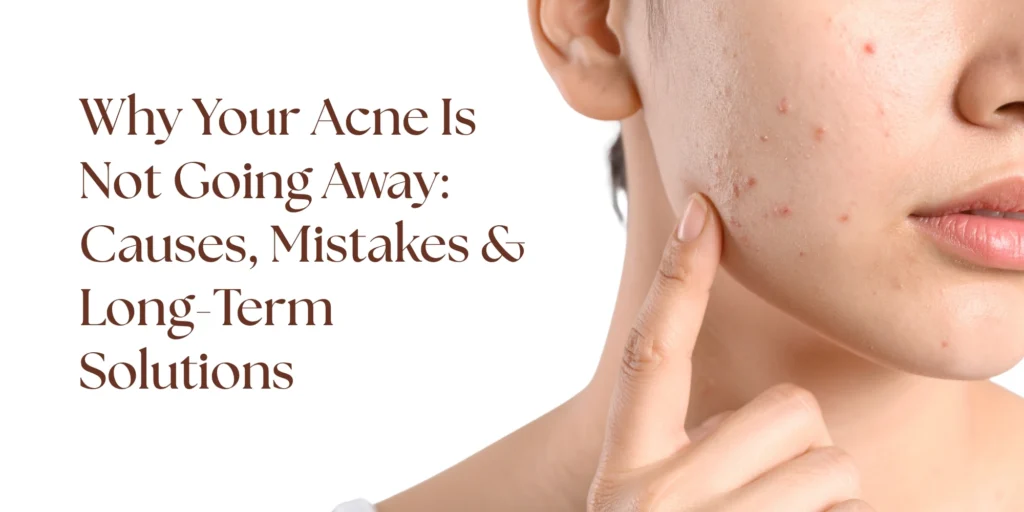
The characteristic pattern of hormonal acne treatment candidates: breakouts concentrated on the chin, jawline, and lower face, worsening in the week before the period, and often presenting as deeper, more painful cystic lesions rather than surface whiteheads.
No cleanser or topical spot treatment will stop hormonally driven acne because the sebaceous gland overactivity creating it is systemic, driven from within the body, not from the surface. Effective hormonal acne treatment requires a dermatologist assessment, often including blood work, and may involve prescription oral medications, anti-androgen therapy, or a combination approach alongside topical management.
Bacterial Resistance
Propionibacterium acnes, the bacteria that contributes to acne, can develop resistance to commonly used topical antibiotics, particularly when those antibiotics are used inconsistently or for extended periods without combination therapy.
Patients who have used topical clindamycin or erythromycin for months without significant improvement are often dealing with a resistant bacterial environment. Continuing the same antibiotic produces no further improvement and may actively worsen the bacterial balance of the skin. This requires a dermatologist-guided switch in treatment approach, not more of the same product.
Incorrect Skincare Products
This is the mistake category that surprises most patients: the products in your routine may actively be perpetuating your acne.
Common skincare-driven acne triggers include:
- Heavy moisturizers and makeup products with comedogenic ingredients, silicones, mineral oils, and certain waxes, that physically block pores
- Over-cleansing and over-exfoliating that strip the skin barrier, trigger reactive sebum overproduction, and create the exact environment acne thrives in
- Layering multiple active ingredients, salicylic acid, benzoyl peroxide, retinol, and AHAs, simultaneously without adequate skin barrier support, causing chronic low-grade inflammation that perpetuates breakouts
- Using products formulated for dry skin on acne-prone oily skin, loading the skin with occlusives it cannot tolerate
Diet and Lifestyle Factors
The relationship between diet and acne is more clinically established than skincare marketing typically acknowledges. High-glycemic diets, refined carbohydrates, sugar, white rice, processed foods, spike insulin levels, which in turn increase androgen activity and sebum production. The mechanism is real and clinically documented.
Dairy, particularly milk, has a separate association with acne through insulin-like growth factor (IGF-1), which stimulates sebaceous activity. The evidence is not universal across all patients, but for acne-prone individuals, dairy reduction is worth trialling under dermatologist guidance.
Chronic stress elevates cortisol, which stimulates sebum production and triggers inflammatory pathways that worsen existing acne. Sleep deprivation drives the same cortisol-driven mechanism. These are not peripheral factors, for many patients they are central ones.
Body Acne Treatment: A Separate Consideration
Acne, on the back, chest, and shoulders, is driven by the same fundamental mechanisms as facial acne but presents different management challenges. Body skin has larger, denser sebaceous glands. Sweat, friction from clothing, and post-workout skin environment all contribute. The trunk area is also more prone to fungal acne, Malassezia folliculitis, which looks identical to bacterial acne but does not respond to conventional acne treatments and actually worsens with certain topical antibiotics.
Body acne treatment requires correct identification of whether the acne is bacterial, fungal, or mixed, which requires a dermatologist assessment. Treating presumed bacterial body acne with antifungals or vice versa is one of the most common reasons body acne does not respond to treatment.
Mistakes That Make Acne Worse
Over-washing the face: Cleansing more than twice daily strips the skin’s natural lipid barrier, causing the sebaceous glands to compensate with more oil production. More oil means more breakouts. The target is balance, not squeaky-clean skin.
Picking and squeezing: Manual extraction of pimples introduces additional bacteria into the follicle, deepens the inflammation, increases the risk of scarring, and almost always makes the individual lesion worse, not better. It is also the primary mechanism by which localized acne spreads to adjacent areas.
Stopping treatment too soon: Acne treatments, particularly retinoids and oral medications, require 6 to 8 weeks before meaningful results are visible. Most patients stop after 3 to 4 weeks because they do not see immediate results, sometimes during a purging phase where breakouts appear temporarily worse. Stopping too early ensures the treatment never reaches its effective phase.
Using too many products simultaneously: The instinct to layer everything that claims to help acne, multiple acids, multiple actives, multiple spot treatments, overwhelms the skin barrier and creates a state of chronic irritation that perpetuates inflammation. A simpler, correctly chosen routine consistently outperforms an overcomplicated one.
Ignoring post-acne marks: Post-inflammatory hyperpigmentation from acne is not the same as active acne. Many patients continue treating marks with acne products that are not appropriate for pigmentation, while the actual active breakouts underneath continue because the real driver has not been addressed.
Long-Term Solutions: What Actually Works
Sustainable acne clearance requires identifying and treating the specific driver, not applying a generic protocol and hoping it works. At AK Dermacare, Dr. Parul Garg’s approach to persistent acne involves:
Complete skin and medical assessment: Including review of hormonal history, menstrual cycle patterns, diet, stress levels, current skincare, and medication history. For suspected hormonal acne, blood work assessing androgen levels, thyroid function, and insulin sensitivity.
Prescription topical therapy: Retinoids remain the most evidence-based topical treatment for acne, regulating cell turnover, preventing pore blockage, and reducing post-acne pigmentation simultaneously. Prescription-strength retinoids are significantly more effective than over-the-counter retinol. Combined with correctly selected antibacterials and non-comedogenic moisturizers, a prescription topical protocol produces results that no over-the-counter routine can replicate.
Oral medications where indicated: For moderate to severe acne, hormonal acne in women, or cases with scarring risk, oral medications, antibiotics, hormonal therapy, or isotretinoin for appropriate candidates, address the internal drivers that topical products cannot reach.
In-clinic treatments: Salicylic acid peels, hormonal acne treatment protocols, and targeted treatments for post-acne marks are sequenced alongside home care to accelerate clearance and address the pigmentation and textural damage that persistent acne leaves behind.
Long-term maintenance: Acne is a chronic condition in many patients, not a problem that disappears permanently after one treatment course. Dr. Parul Garg builds a maintenance protocol that keeps the skin clear after the active treatment phase ends, rather than leaving patients to manage the condition alone once prescription treatment is stopped.
When Should I See a Dermatologist for Acne?
The honest answer is earlier than most people do.
See a dermatologist if:
- Over-the-counter treatments have not produced clear improvement after 8 to 12 weeks of consistent use
- You have cystic or nodular acne, deep, painful, under-the-skin lesions that do not respond to topical products and carry significant scarring risk
- Acne is leaving dark marks or scars that are accumulating over time
- Breakouts are clearly linked to your menstrual cycle, hormonal changes, or a diagnosed condition like PCOS
- You have tried multiple treatment approaches without lasting results and the acne keeps coming back regardless of what you use
The risk of waiting is not just continued breakouts. Every cystic lesion that inflames deeply and resolves slowly leaves a potential scar. Scarring from acne is significantly harder and more expensive to treat than the acne itself. Early dermatologist intervention prevents the problem from compounding.
At AK Dermacare in West Delhi, Dr. Parul Garg sees acne patients at every stage, from early intervention through to post-acne scar management, and the patients who come in earlier consistently achieve better long-term outcomes than those who wait until the damage is done.
Final Thoughts
Acne keeps coming back when the cause is not addressed. Not because you are using the wrong cleanser. Not because your routine is not consistent enough. But because something underneath, a hormone, a bacteria, a dietary pattern, a skincare ingredient, or a combination, is driving the skin to keep producing breakouts regardless of what you apply to the surface.
The solution is not more products. It is a correct diagnosis followed by a treatment plan that targets the actual cause. At AK Dermacare in West Delhi, Dr. Parul Garg builds exactly that, a clinical, evidence-based approach to acne that clears the skin and keeps it clear, rather than managing the same breakouts indefinitely without progress. Because skin that keeps breaking out deserves more than another spot treatment.
Frequently Asked Questions (FAQs)
1. Why does my acne keep coming back?
Recurring acne almost always has an unaddressed underlying driver, hormonal fluctuations, bacterial resistance, comedogenic skincare products, diet, chronic stress, or a combination. Surface treatments manage existing breakouts but do not stop the cause from creating new ones. Hormonal acne treatment, prescription topicals, and dermatologist-guided dietary and lifestyle changes address the driver rather than just the symptom. If your acne keeps returning despite consistent treatment, the cause has not yet been correctly identified or treated.
2. How long does acne take to clear?
With the correct treatment protocol, most patients see meaningful visible improvement in 6 to 8 weeks. Significant, sustained clearance, where breakouts are rare rather than frequent, typically takes 3 to 6 months. Hormonal acne treatment and cases involving cystic acne or PCOS may require a longer management timeline. The initial 2 to 4 weeks of starting a retinoid or prescription topical often involve a temporary purging phase where breakouts appear to worsen before they improve, this is expected and not a reason to stop treatment.
3. Why is my acne worse after treatment?
An increase in breakouts in the first 2 to 4 weeks after starting retinoids or certain chemical exfoliants is called purging, it reflects accelerated cell turnover bringing existing congestion to the surface faster than usual. It is temporary and resolves as the treatment establishes. True worsening beyond 6 weeks, or new types of lesions appearing, suggests either an incorrect treatment choice, a comedogenic product in the routine, or an unaddressed underlying trigger. If this is your experience, a dermatologist assessment is the correct next step rather than continuing the same approach.
4. When should I see a dermatologist for acne?
See a dermatologist if over-the-counter treatments have not produced clear improvement after 8 to 12 weeks, if you have cystic or nodular acne, if breakouts are leaving dark marks or scars, if acne is clearly linked to hormonal cycles or PCOS, or if acne keeps coming back regardless of what you try. Early dermatologist intervention produces better long-term outcomes and prevents the scarring and post-inflammatory pigmentation that accumulates when persistent acne is undertreated for extended periods.