
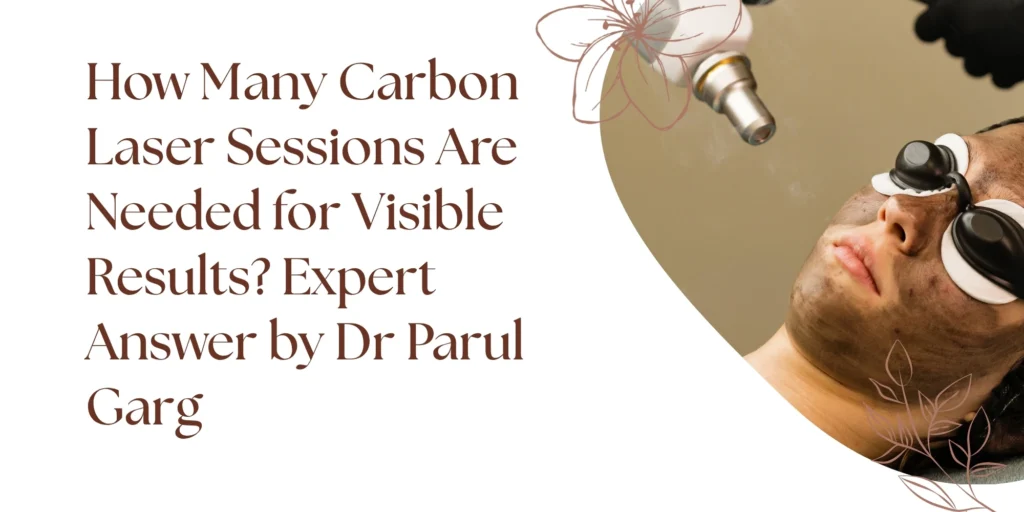
Carbon laser peel delivers visible improvement from the very first session but how many sessions you actually need depends on what you are trying to achieve and what your skin looks like when you start. A single session produces immediate glow, pore refinement, and smoothness. A course of 4 to 6 sessions produces meaningful, lasting improvement in skin texture, tone, pigmentation, and oil control. At AK Dermacare in West Delhi, Dr. Parul Garg assesses each patient’s skin individually and builds a session plan around their specific concerns, starting skin condition, and realistic goals because the right number of sessions is not the same for everyone, and a generic answer is not good enough.
Key Takeaways
How many sessions are needed for visible results? One session delivers immediate glow. For meaningful improvement in texture, tone, and pigmentation, 4 to 6 sessions spaced 2 to 3 weeks apart is the clinical standard.
What do the benefits of carbon laser peel include? Deep pore cleansing, dead skin removal, sebum regulation, collagen stimulation, skin brightening, mild pigmentation improvement, and pore size reduction — all in a zero-downtime procedure.
How long does the carbon laser peel effect last? Single session results last 1 to 2 weeks. A full course produces improvements that last several months, particularly with sun protection and maintenance sessions.
Is carbon laser peel the same as carbon laser toning? The terms are often used interchangeably. Both use a carbon layer with Q-switched Nd:YAG laser energy. The distinction, where it exists, is in energy settings — carbon laser toning uses lower fluence settings for progressive skin toning with even less surface reaction.
Introduction
Most patients asking about carbon laser peel sessions are really asking two separate questions, even if they phrase them as one.
The first question is: will I see a difference? The answer is yes — typically from the first session.
The second question is the one that actually matters for planning: how many sessions do I need before the improvement is genuinely significant and not just a good skin day? That answer is more specific and more honest than most clinics give, which is why this blog exists.
Dr. Parul Garg at AK Dermacare has treated hundreds of patients with carbon laser peel across a range of skin concerns from pre-event glow sessions to full courses targeting melasma, acne-prone oily skin, and textural dullness. The session count question comes up in every consultation. Here is the complete, unfiltered answer.
What Happens to Your Skin in Each Session
Understanding what carbon laser peel does biologically makes the session count question much easier to answer.
When the carbon layer is applied and the Q-switched Nd:YAG laser passes over it, two distinct things happen simultaneously:
Superficial action: The laser vaporizes the carbon particles along with the dead skin cells, sebum, oil, and debris bonded to them. This is the mechanism behind the immediate post-peel glow — the dull, congested surface layer is removed in a single pass, revealing the fresher skin underneath. This happens in every session.
Deeper action: The laser energy penetrates beyond the carbon layer and delivers controlled thermal stimulation to the dermis. This stimulates fibroblasts to produce new collagen and elastin, regulates sebaceous gland activity, and progressively targets superficial melanin deposits. These deeper effects accumulate across sessions — they do not reach their full potential in a single treatment.
This dual mechanism explains why one session gives you a glow and six sessions give you genuinely different skin. The surface benefit is immediate. The structural benefit is progressive and cumulative.
Session by Session: What to Expect
Session 1: Immediate improvement in skin brightness and smoothness. Pores appear visibly cleaner. Skin feels lighter and more refined. The glow is real and noticeable — not subtle. This result lasts approximately 1 to 2 weeks before the skin returns to its baseline. For many patients, session one is the confirmation that the treatment works.
Sessions 2 and 3: The cumulative effect of collagen stimulation begins to show. Skin texture improves beyond what can be attributed to simple exfoliation. Pore size starts to reduce structurally, not just from clearing. Oily skin patients notice meaningfully less sebum production between sessions. Post-acne marks begin to lighten.
Sessions 4 and 5: Visible improvement in skin tone and evenness. Pigmentation and superficial post-inflammatory marks have reduced measurably. Skin feels firmer and looks more consistently luminous between sessions, not just immediately after. The improvement is now holding rather than fading within days.
Session 6 and beyond: For patients with more established concerns — deeper pigmentation, significantly enlarged pores, or pronounced textural irregularities — sessions 5 and 6 consolidate and extend what earlier sessions built. The result is skin that looks fundamentally better than it did before the course, not just better than it did yesterday.
Carbon Laser Peel Before and After: What Changes and What Does Not
Understanding realistic carbon laser peel before and after expectations prevents both disappointment and the temptation to stop too early.
What carbon laser peel consistently improves across a full course:
- Overall skin brightness and luminosity — this is the most consistent and universal result
- Pore size — structural reduction from collagen remodeling around pore openings
- Skin texture — smoothness and evenness improve measurably
- Sebum control — oily and combination skin patients see meaningful oil reduction
- Superficial pigmentation and post-acne marks — progressive lightening across sessions
- Mild fine lines — early improvement from cumulative collagen stimulation
What carbon laser peel does not replace:
- Deep melasma treatment — carbon laser toning addresses superficial pigmentation effectively, but deep dermal melasma requires a dedicated Q-switched laser toning protocol at appropriate parameters
- Deep acne scarring — ice-pick and boxcar scars need fractional laser or microneedling for significant correction
- Significant skin laxity — collagen stimulation from carbon peel addresses early firmness loss, not advanced sagging
At AK Dermacare, Dr. Parul Garg gives every patient an honest pre-treatment assessment of what their specific carbon laser peel before and after will realistically look like — and whether additional or alternative treatments better suit their primary concern.
How Many Sessions Do You Specifically Need
The honest answer is that it depends on three things: your starting skin condition, your primary concern, and your maintenance commitment. Here is how Dr. Parul Garg approaches this at AK Dermacare:
| Skin Concern | Recommended Sessions | Spacing |
| Single pre-event glow session | 1 session | 5 to 7 days before event |
| General brightening and maintenance | 3 to 4 sessions | Every 2 to 3 weeks |
| Oily skin and enlarged pores | 5 to 6 sessions | Every 2 to 3 weeks |
| Superficial pigmentation and uneven tone | 5 to 6 sessions | Every 2 to 3 weeks |
| Post-acne marks and skin texture | 6 sessions minimum | Every 2 to 3 weeks |
| Ongoing maintenance after initial course | 1 session monthly or bi-monthly | As assessed |
Benefits of Carbon Laser Peel: The Complete Clinical Picture
The benefits of carbon laser peel extend beyond what most patients expect going in. Here is what the treatment delivers across a properly structured course:
Zero downtime: Unlike chemical peels or fractional laser, carbon peel produces no visible peeling, flaking, or recovery period. Patients return to normal activity the same day, which is why it is practical as a regular maintenance treatment rather than a once-a-year intervention.
Suitable for all Indian skin tones: The Q-switched Nd:YAG 1064 nm laser used in carbon laser peel treatment is validated as safe for darker Fitzpatrick skin types (III to VI). The carbon layer absorbs the laser energy, which means the skin itself is not the primary target — significantly reducing the risk of post-inflammatory hyperpigmentation that more aggressive treatments pose on Indian skin.
Sebum regulation: The thermal effect on sebaceous glands reduces oil production progressively across sessions. This is one of the most clinically meaningful benefits for patients with oily or acne-prone skin — not just surface cleansing but actual gland regulation.
Collagen stimulation: The dermal heating effect from each session stimulates new collagen synthesis. The improvement in skin firmness, fine line reduction, and pore tightening that accumulates across a course is driven by this structural collagen remodeling — not just surface exfoliation.
Safe to combine with other treatments: Carbon laser toning sessions can be combined with or sequenced alongside laser toning, skin boosters, or chemical peels as part of a comprehensive skin rejuvenation protocol. At AK Dermacare, Dr. Parul Garg designs combination protocols where multiple concerns are addressed efficiently.
Are There Any Side Effects of Carbon Laser Peel?
Carbon laser peel has one of the most favorable side effect profiles of any active skin treatment. When performed by a qualified dermatologist with correctly calibrated parameters, adverse effects are minimal and temporary.
Common and expected — all temporary:
- Mild redness or skin warmth for 1 to 3 hours post-session
- Slight tightness or dryness for 24 to 48 hours
- Temporary darkening of existing pigmentation spots for a few days as superficial melanin fragments before clearing
Rare, and almost always linked to incorrect parameters or unqualified operators:
- Post-inflammatory hyperpigmentation — the most significant risk for Indian skin, caused by excessive laser energy or incorrect settings
- Prolonged redness beyond 24 hours
- Surface sensitivity or mild irritation in patients with compromised skin barriers
What Should Be Considered After Carbon Laser Peel?
Post-session care directly affects how well your results develop and how long they last. These are not optional suggestions — they are the clinical instructions that protect your skin between sessions:
Sun protection is non-negotiable: Apply SPF 30 or higher on treated areas every day throughout your course and beyond. Post-peel skin is more reactive to UV exposure, and unprotected sun exposure between sessions is the single most common reason results are compromised on Indian skin.
Avoid heat sources for 24 to 48 hours: Hot showers, saunas, steam rooms, and intense exercise raise skin temperature and prolong the post-treatment inflammatory response. Use lukewarm water and avoid heat-generating activities for the first two days after each session.
Pause active skincare ingredients for 48 hours: Retinol, AHAs, BHAs, and vitamin C at high concentrations should not be used on treated skin for 48 hours post-session. Resume your normal skincare routine from day three onward.
Do not attempt to accelerate hair or skin shedding: In the days after a session, the treated skin surface sheds naturally. Do not scrub, exfoliate, or attempt to speed this process. It causes unnecessary irritation and does not improve outcomes.
Keep skin moisturized: A fragrance-free ceramide moisturizer or aloe vera gel applied twice daily for the first week supports barrier recovery and reduces post-session dryness.
Recommendations for Those Considering Carbon Laser Peel
If you are considering carbon laser peel at AK Dermacare, here is what Dr. Parul Garg recommends before you book:
Be clear about your primary concern: Single session glow, a pre-event course, ongoing oily skin management, and post-acne mark treatment all have different optimal protocols. Clarity about your goal helps build the right plan from the start.
Commit to the full course: The patients who see the most significant carbon laser peel before and after improvement are those who complete their full recommended course rather than stopping after two sessions because the initial glow satisfied them temporarily. The structural benefits require the full course to develop.
Start sun protection before you begin: If you are not already using daily SPF, start at least two weeks before your first session. Sun-damaged or actively tanned skin complicates treatment and reduces efficacy on Indian skin tones.
Book a consultation before your first session: A pre-treatment skin assessment determines the correct protocol, identifies any contraindications, and sets honest expectations for what your specific skin will look like after a full course.
Final Thoughts
The question is not really how many sessions carbon laser peel needs. The question is what you want your skin to look like — and how seriously you are willing to invest in a structured plan to get there. One session gives you a glow. Six sessions give you different skin. Both are legitimate goals. The one that is right for you depends on what you are starting with and what you are trying to achieve.
At AK Dermacare in West Delhi, Dr. Parul Garg builds every carbon laser toning and peel protocol around the individual patient, not a standard menu. The consultation is where that plan begins. The results are what make it worth it.
Frequently Asked Questions (FAQs)
1. Recommendations for those considering carbon peeling?
Start with a dermatologist consultation rather than booking a session directly. A pre-treatment skin assessment identifies your specific concerns, determines the right number of sessions, checks for contraindications, and sets realistic expectations. Commit to the full recommended course rather than stopping after one or two sessions. Begin daily SPF use at least two weeks before your first session, and disclose your full skincare routine and medication history at the consultation.
2. Are there any side effects of carbon peeling?
Side effects are mild and temporary when the procedure is performed correctly. Most patients experience mild redness or warmth for 1 to 3 hours post-session and slight dryness for up to 48 hours. Serious side effects including post-inflammatory hyperpigmentation are rare and almost exclusively linked to incorrect energy parameters or unqualified operators. At AK Dermacare, Dr. Parul Garg calibrates parameters specifically for your skin tone and assesses skin response after each session before proceeding.
3. How long does the carbon peeling effect last?
The immediate post-session glow and smoothness last approximately 1 to 2 weeks after a single session. A full course of 4 to 6 sessions produces collagen stimulation, pore tightening, and pigmentation improvement that persists for several months with correct sun protection and maintenance. Monthly or bi-monthly maintenance sessions after the initial course extend results significantly and keep the skin in consistently better condition long-term.
4. What should be considered after carbon peeling?
Apply SPF 30 or higher daily on treated areas throughout your course and afterward. Avoid heat sources including hot showers, saunas, and intense exercise for 24 to 48 hours post-session. Pause retinol, AHAs, and BHAs for 48 hours after each session. Do not scrub or physically exfoliate the treated area during the first week. Apply a fragrance-free moisturizer twice daily for the first week to support skin barrier recovery.