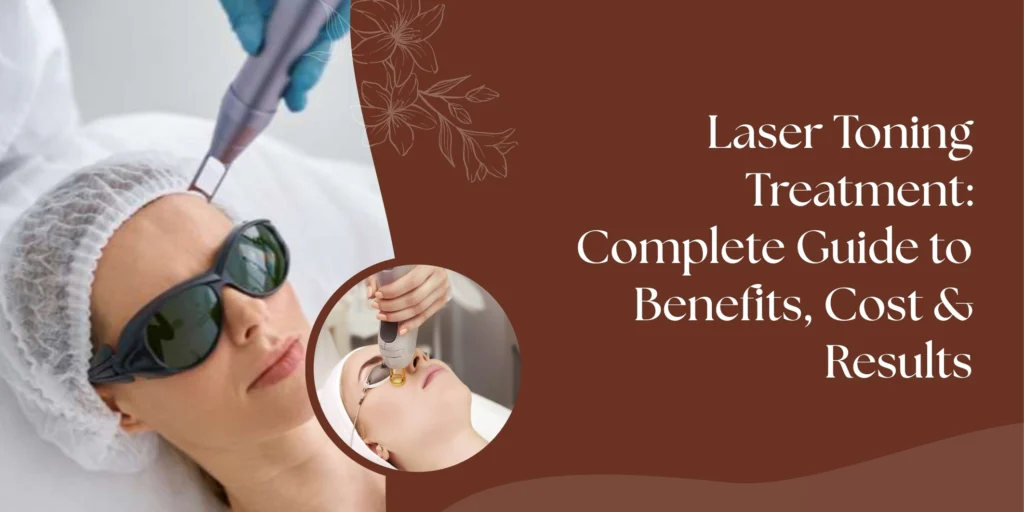
Laser toning treatment is a non-invasive, zero-downtime skin rejuvenation procedure that uses a Q-switched Nd:YAG laser to target and fragment melanin deposits responsible for pigmentation, dark spots, melasma, and uneven skin tone , while simultaneously stimulating collagen production for firmer, more refined skin. It is one of the most versatile and widely recommended skin brightening treatments available, delivering progressive improvement in tone, texture, and radiance across a course of sessions with no recovery period. At AK Dermacare in West Delhi, Dr. Parul Garg customizes laser skin toning protocols to each patient’s skin concern, Fitzpatrick tone, and treatment goals , making it suitable for everything from laser toning for melasma to post-acne hyperpigmentation, pore minimization, and overall skin rejuvenation.
Key Takeaways
- What does laser toning treat? Melasma, sun-induced pigmentation, post-acne dark marks, uneven skin tone, enlarged pores, dullness, fine lines, and mild acne scarring , in a single treatment platform with no downtime.
- Is laser toning safe for Indian skin? Yes. The Q-switched Nd:YAG laser at 1064 nm is specifically validated for darker Indian skin tones (Fitzpatrick III–VI) and is the gold standard for skin pigmentation treatment in Indian dermatology practice.
- How many sessions are needed? Most patients need 6–10 sessions spaced 2–4 weeks apart for significant results. Maintenance sessions every 4–8 weeks sustain improvement.
- Is laser toning permanent? Laser toning permanently removes existing pigmentation deposits. Sun-induced and hormonally driven pigmentation (melasma) can recur without strict photoprotection and maintenance.
The question that arrives in nearly every consultation at AK Dermacare is some version of this: “Doctor, I have been using brightening serums, SPF every day, and prescription creams for months , but my pigmentation is still there, my skin still looks dull, and my pores are visible. What else can I do?”
It is a fair question. And the honest answer is that topical skincare, however well chosen, has a ceiling. It works on the surface. It cannot reach the melanin deposits sitting in the mid-dermis that are responsible for deep melasma. It cannot fragment the pigment clusters that cause persistent dark spots. And it cannot trigger the collagen remodeling that refines pores and firms skin from within.
Laser toning treatment delivers targeted light energy that topical products simply cannot replicate, producing progressive, measurable improvement in pigmentation, tone, and texture across a structured course of sessions. And it does all of this with zero downtime, zero peeling, and a safety profile that is specifically validated for darker Indian skin. This guide covers everything: how laser skin toning works, what it treats, what results look like, what it costs, and how to choose the right clinic.
How Laser Toning Treatment Works , The Science Explained
Laser toning treatment operates on the principle of selective photothermolysis , the same foundational mechanism behind most medical laser procedures. Here is what happens at the cellular level during a session.
The Q-switched Nd:YAG laser delivers ultra-short, high-energy pulses of laser light , at nanosecond durations , to the skin. At the 1064 nm wavelength used for laser toning, this light energy passes through the outermost skin layers and is selectively absorbed by melanin pigment deposits deeper in the skin. The energy is absorbed and converted to mechanical photoacoustic shockwaves that shatter the melanin clusters into microscopic fragments , small enough for the body’s lymphatic and immune system to clear naturally over the following weeks.
Simultaneously, the laser energy generates controlled thermal stimulation in the dermis , the deeper structural layer of the skin , triggering fibroblast activation and new collagen and elastin synthesis. This dermal remodeling is what produces the improvements in skin firmness, pore size, and fine line reduction that accumulate progressively across sessions.
Because the Q-switched laser treatment uses ultra-short pulses, heat does not build up in the surrounding tissue , the target (melanin) is destroyed without overheating the skin surface. This is the mechanism that makes it safe for darker Indian skin tones that more heat-dependent lasers would damage.
Laser Toning Benefits: What Improves and Why It Matters
Reduces Pigmentation and Dark Spot
The most sought-after laser toning benefit is its ability to address hyperpigmentation removal across multiple types simultaneously. Whether the cause is sun exposure, post-acne marks (post-inflammatory hyperpigmentation), hormonal melasma, or age spots , the Q-switched Nd:YAG laser fragments melanin deposits progressively across sessions. Patients who have carried the same dark marks for years consistently see significant lightening and clearing that topical hyperpigmentation removal products could not deliver.
Laser Toning for Melasma
Melasma , the hormonally driven, bilaterally symmetrical pigmentation most common in Indian women , is one of the most challenging skin conditions to treat because it sits at multiple depths simultaneously and has a high recurrence rate with sun exposure. Low-fluence Q-switched laser treatment for melasma has become a clinical standard in Indian dermatology because its controlled, progressive energy delivery targets melasma pigment at depth without the high-heat risk of triggering post-inflammatory hyperpigmentation , the primary pitfall when more aggressive lasers are used on Indian skin.
Laser toning for melasma at AK Dermacare is always combined with Dr. Parul Garg’s melasma management protocol , including prescription topical agents and strict photoprotection , because treating the pigmentation without managing the recurrence trigger produces temporary results at best.
Collagen Stimulation and Skin Firming
Beyond pigmentation, the dermal thermal effect of laser skin toning stimulates new collagen synthesis that improves skin firmness, reduces fine lines, and tightens mild skin laxity progressively across sessions. Patients notice this benefit most clearly from sessions 4–5 onward , a gradual lifting and firming of the skin quality that photographs as a more youthful, even-surfaced complexion.
Pore Minimization
Enlarged pores , a combination of genetic predisposition, sebum overproduction, and the loss of collagen support in the surrounding dermis , respond meaningfully to laser skin toning. The collagen remodeling effect tightens the dermal architecture around pore openings, reducing their visible diameter progressively. Combined with the sebaceous gland regulation effect of the Nd:YAG wavelength, oil production decreases alongside pore size , a dual benefit particularly valuable for patients in Delhi’s climate.
Overall Skin Brightening and Radiance
Beyond targeted concern treatment, laser toning treatment delivers a generalized skin brightening and luminosity improvement that patients describe as their skin simply looking more alive and healthier , the same effect seen after a carbon peel, but driven by deeper collagen and melanin action rather than surface exfoliation alone.
Acne Scar Improvement
For post-acne hyperpigmentation and superficial atrophic scarring, laser skin toning delivers progressive improvement alongside its pigmentation benefits. It is not the primary treatment for deep ice-pick or boxcar scars , fractional laser or microneedling addresses those more directly , but as part of a combined acne scar protocol, it contributes meaningfully to overall skin surface clearance.
Laser Toning Before and After: What Results Look Like Session by Session
Understanding the progression of results prevents the discouragement that sometimes leads patients to stop treatment before the cumulative improvement fully develops.
- Sessions 1–2: Mild brightening and a more rested, even appearance. Existing dark spots may appear temporarily darker for a few days before lightening , this is the melanin fragmentation process working correctly, not a sign of worsening. Skin feels smoother.
- Sessions 3–4: Visible reduction in post-acne marks and surface pigmentation. Skin tone evening is clearly apparent. Pores appear slightly more refined. Patients with melasma begin noticing lightening of the most superficial pigment layers.
- Sessions 5–6: Significant pigmentation improvement across treated areas. Collagen remodeling begins manifesting as improved skin firmness and texture. Overall complexion appears noticeably brighter and more uniform.
- Sessions 7–10: Deeper melasma and more established hyperpigmentation continues to improve. Skin quality , not just tone but firmness, smoothness, and radiance , is substantially transformed from the starting point.
Beyond the initial course: Maintenance sessions every 4–8 weeks prevent pigmentation reaccumulation, sustain collagen activity, and keep results stable long-term , particularly important for laser toning for melasma where sun exposure continuously drives recurrence.
Laser Toning Side Effects: What to Expect and What to Watch For
Laser toning treatment has one of the safest side effect profiles of any energy-based skin treatment , particularly when performed by a qualified dermatologist with correctly calibrated parameters for Indian skin.
Common, expected, and temporary:
- Mild redness or warmth immediately post-session , resolves within 1–3 hours
- Temporary darkening of targeted pigmentation spots for 3–7 days before they lighten and clear , a sign the treatment is working
- Mild dryness or sensitivity for 24–48 hours post-session
Rare, and almost always linked to incorrect parameters or unqualified operators:
- Post-inflammatory hyperpigmentation , the most serious risk for Indian skin, caused by excessive energy settings or incorrect wavelength selection that overheats the skin surface. This is why dermatologist-controlled parameters matter fundamentally
- Blistering or burns , extremely rare with properly calibrated Q-switched laser treatment but can occur at excessive fluences
- Paradoxical darkening with prolonged high-intensity sessions
Minimizing risk: The combination of a qualified dermatologist, correctly calibrated energy parameters for your specific Fitzpatrick skin tone, and strict post-treatment sun protection eliminates the vast majority of laser toning side effects. At AK Dermacare, Dr. Parul Garg performs a pre-treatment assessment and starts at conservative parameters for new patients, adjusting based on skin response.
Laser Toning vs Other Treatments: How It Compares
| Treatment | Downtime | Pigmentation | Collagen | Safe for Indian Skin | Sessions Needed |
| Laser toning (Q-switched) | None | Excellent | Yes , progressive | Yes , gold standard | 6–10 |
| Chemical peel | 3–7 days | Good , surface only | Mild | With correct selection | 4–6 |
| Carbon laser peel | None | Good , surface | Yes | Yes | 4–6 |
| Fractional laser | 5–7 days | Moderate | Excellent | With caution | 3–5 |
| Topical brightening agents | None | Mild , surface only | No | Yes | Ongoing |
| IPL | 2–3 days | Moderate | Mild | Caution , higher PIH risk | 4–6 |
The specific advantage of laser toning treatment over chemical peels and topical agents is depth of pigmentation action combined with zero downtime. The advantage over fractional laser is the complete absence of recovery time. The advantage over IPL for Indian skin is the lower risk of post-inflammatory hyperpigmentation at the 1064 nm wavelength , making it the preferred skin pigmentation treatment platform in Indian dermatology for darker skin tones.
Laser Toning Cost: What Determines the Price
Laser toning cost in India varies based on several factors , and understanding what drives the variation helps patients make informed decisions rather than choosing on price alone.
Factors that determine laser toning cost:
- Treatment area: Face only vs. face and neck vs. full face, neck, and décolletage
- Number of sessions: Single sessions vs. package pricing for a full course
- Clinic qualification: Dermatologist-led medical clinics vs. beauty salons using substandard equipment
- Technology used: Medical-grade Q-switched Nd:YAG laser platforms vs. lower-powered aesthetic devices
- Concurrent treatments: Combined protocols (laser toning + carbon peel, or laser toning + skin boosters) in the same session
At AK Dermacare in West Delhi, laser toning cost is discussed transparently during the initial consultation , with package pricing available for full courses and combination protocols. Dr. Parul Garg recommends a consultation first specifically because the number of sessions and the appropriate protocol depend on clinical assessment, not a generic price list.
A note on price shopping: Laser toning side effects , particularly post-inflammatory hyperpigmentation , occur almost exclusively in clinics using incorrect energy parameters or unqualified operators. The savings from choosing a cheaper, unqualified provider can cost significantly more in corrective treatment. For a procedure performed on your face with a medical-grade laser, qualification and expertise are non-negotiable variables.
Best Laser Toning Near Me: How to Choose the Right Clinic
The most searched phrase by patients after reading about laser toning treatment is typically some version of “best laser toning near me” , and the criteria for making that choice well are worth spelling out clearly.
What to look for:
Dermatologist qualification: Laser skin toning must be performed or directly supervised by an MD dermatologist , not a technician, therapist, or cosmetologist. The energy parameter decisions that determine safety and efficacy on Indian skin require medical training and clinical judgment.
Medical-grade Q-switched Nd:YAG laser: Not all lasers used for “toning” are equivalent. The Q-switched Nd:YAG laser at 1064 nm is the clinical standard for non-invasive skin rejuvenation in Indian skin. Ask specifically what laser the clinic uses and what its wavelength and pulse duration are.
Pre-treatment consultation: Any clinic that offers laser toning treatment without a pre-treatment skin assessment is not operating safely. Parameters must be calibrated to your Fitzpatrick skin tone, existing pigmentation depth, and skin sensitivity.
Transparent expectations: The best clinics , including AK Dermacare , tell you what results are achievable for your specific concern, what the realistic timeline is, and what maintenance is needed. Clinics that promise dramatic results in one or two sessions are not being honest.
Post-treatment care protocol: A qualified clinic provides specific aftercare instructions , including sun protection after laser toning guidelines , and schedules follow-ups to monitor progress. Without this framework, even a well-performed session is at risk of disappointing outcomes.
Why Choose AK Dermacare for Laser Toning Treatment
For patients in West Delhi seeking laser skin toning for pigmentation, melasma, dullness, pores, or overall skin rejuvenation, AK Dermacare under Dr. Parul Garg offers a clinically rigorous, fully personalized approach to every treatment course.
- Dermatologist-Controlled Parameters: Every laser toning treatment session at AK Dermacare is administered under Dr. Parul Garg’s direct supervision , with energy settings calibrated specifically to your Fitzpatrick skin tone, pigmentation type, and session-by-session skin response.
- Medical-Grade Q-Switched Nd:YAG Laser: The clinical gold standard for skin pigmentation treatment and non-invasive skin rejuvenation in Indian skin , not a consumer-grade aesthetic device.
- Complete Pigmentation Management: Laser toning for melasma and other pigmentation concerns at AK Dermacare is integrated with concurrent topical protocols, photoprotection guidance, and hormonal assessment where relevant , because treating pigmentation without managing the driver produces temporary results.
- Combination Protocol Capability: For patients whose concerns extend beyond what laser toning alone addresses, Dr. Parul Garg integrates it with HydraFacial, chemical peels, skin boosters, or carbon laser peel in appropriately sequenced combination protocols.
- Honest, Transparent Consultations: Dr. Parul Garg sets realistic expectations at every consultation , based on your specific skin, your pigmentation depth, and the clinical evidence for your concern type. No promises of overnight transformation , only accurate, achievable outcomes explained clearly.
Final Thoughts
Laser toning treatment is one the most significant advances in non-surgical skin improvement available to Indian patients , precisely because it delivers the depth of action that topical skincare cannot, with the safety profile that Indian skin requires, and without the recovery time that more aggressive resurfacing procedures demand.
Laser toning for pigmentation, for melasma, for pore refinement, for collagen stimulation , these are not marketing claims. They are clinically validated outcomes from a well-established procedure with decades of evidence supporting its use in darker skin types. The patients who see the most compelling laser toning before and after results are the ones who start with the right diagnosis, choose a qualified dermatologist, complete a full course consistently, and protect their results with daily SPF.
At AK Dermacare, Dr. Parul Garg’s approach to laser skin toning is built on this framework entirely. If your skin has not responded to topical treatment, or if you want a more significant and lasting improvement in pigmentation, tone, and texture than creams can deliver , the right conversation starts with a consultation that actually looks at your skin properly.
Frequently Asked Questions (FAQs)
1. Is laser toning painful?
No. Laser toning treatment involves only mild warmth and a light snapping or tingling sensation as the laser pulses are delivered , most patients describe it as very comfortable. No numbing cream is typically required, though it can be applied for more sensitive patients. The zero-discomfort profile is one reason patients find it far more approachable than more aggressive laser procedures.
2. How long does each session take?
A full-face laser skin toning session takes approximately 20–30 minutes. When combined with carbon application (carbon-assisted laser toning) or other concurrent treatments, the total session time extends to 45–60 minutes. It is routinely performed as a lunch-break procedure , and patients return to normal activities immediately after.
3. When will I see results?
Mild brightening is visible within 24–48 hours of the first session. Meaningful improvement in pigmentation and skin tone typically becomes clearly apparent from sessions 3–4 onward. Full cumulative transformation from a complete course of 6–10 sessions is most visible at month 3–5. The skin continues to improve between sessions as melanin fragments are cleared and collagen remodeling develops.
4. Is laser toning permanent?
Laser toning treatment permanently removes existing melanin deposits , those specific pigmentation spots do not return. However, sun-induced pigmentation and melasma can recur with continued UV exposure and hormonal triggers. Strict daily SPF 50+, combined with maintenance sessions every 4–8 weeks, sustains results long-term. Think of it as permanent treatment of existing pigmentation, combined with ongoing prevention of new formation.
5. Can I get laser toning in summer?
Yes , with strict sun protection. Laser skin toning can be performed year-round, including summer. The critical requirement is rigorous sun protection after laser toning: SPF 50+ applied every morning and reapplied every 2 hours outdoors, physical sun protection (hat, sunglasses), and avoiding peak sun hours (10 am–4 pm) as much as possible. Dr. Parul Garg adjusts session parameters conservatively during summer months for patients with high outdoor exposure.
6. Can laser toning remove deep acne scars?
Laser toning treatment is highly effective for post-acne hyperpigmentation (flat dark marks) and contributes to superficial textural improvement. For deep atrophic acne scars , ice pick, boxcar, or rolling scars , fractional laser resurfacing, medical microneedling, or subcision are more appropriate primary treatments. Dr. Parul Garg frequently combines laser skin toning with these modalities in an integrated acne scar protocol at AK Dermacare.
7. Can I combine laser toning with other treatments?
Yes , and combination protocols often deliver superior results. Laser toning treatment pairs well with HydraFacial, chemical peels, skin boosters, and carbon laser peel when appropriately sequenced. Combining in the same session or across a structured multi-treatment plan is something Dr. Parul Garg plans individually based on your concern profile and skin response at AK Dermacare.
8. Does it work on active acne?
Laser toning treatment is not the primary treatment for active inflammatory acne , the Nd:YAG wavelength has some antibacterial effect on C. acnes bacteria and reduces sebum, which can be beneficial, but active acne management requires concurrent prescription therapy. Dr. Parul Garg assesses active acne status at consultation and, where present, integrates active acne treatment alongside the laser skin toning protocol rather than using laser toning alone.
9. How to choose the right clinic for laser toning?
Choose a clinic where treatment is performed or directly supervised by a board-certified MD dermatologist, using a medical-grade Q-switched Nd:YAG laser with documented wavelength and parameter specifications. Require a pre-treatment consultation before any session is scheduled. Ask what aftercare protocol and sun protection guidance is provided. Avoid clinics that quote dramatically low prices without a clinical assessment , laser toning side effects on Indian skin occur almost exclusively in under-qualified settings with incorrectly calibrated equipment.
10. What is the difference between Q-switched and Pico laser?
Both target melanin via photoacoustic fragmentation , but at different pulse durations. Q-switched laser treatment delivers pulses in nanoseconds (billionths of a second). Picosecond lasers deliver pulses in picoseconds (trillionths of a second) , shorter by a factor of 1,000. Shorter pulses produce more mechanical shockwave and less heat, meaning Pico lasers can fragment melanin more completely with potentially lower thermal risk. In clinical practice for Indian skin, both are effective for laser toning for pigmentation when correctly calibrated. Q-switched Nd:YAG has the longer and more extensive evidence base for Indian skin; Pico laser is increasingly used for resistant melasma and tattoo removal. Dr. Parul Garg recommends clinical assessment at AK Dermacare.
11. Can laser toning treat birthmarks?
Some birthmarks , particularly café-au-lait macules and certain melanocytic nevi , respond to Q-switched laser treatment. Others, depending on depth and cell type, do not. Vascular birthmarks (port wine stains, haemangiomas) require different laser wavelengths entirely. Every birthmark requires individual clinical assessment before any laser treatment is recommended. Dr. Parul Garg evaluates birthmarks at consultation and advises whether laser skin toning is appropriate or whether a different approach is needed.