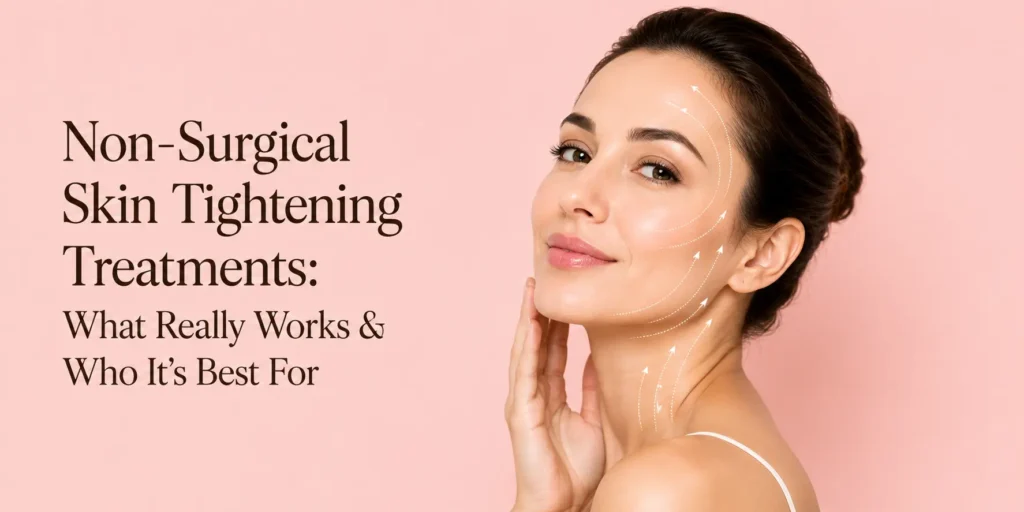
Non-surgical skin tightening treatments have advanced significantly over the past decade, and the best of them produce genuine, measurable improvement in skin laxity, facial contour, and neck definition without surgery, anaesthesia, or meaningful recovery time. The key word is best. Not every technology marketed as skin tightening delivers equivalent results, and the outcome depends as much on correct patient selection as it does on which device is used. At AK Dermacare, the leading skin tightening clinic in West Delhi, Dr. Parul Garg assesses each patient’s skin laxity, tissue quality, and clinical goal before recommending any treatment, because the most effective non-surgical tightening is always the one matched to what the skin actually needs.
Key Takeaways
What is the best non-surgical skin tightening treatment? HIFU is currently the most clinically validated non-surgical option for true tissue lifting and tightening, targeting the deep structural layer that surgical facelifts address. Radiofrequency treatments are effective for surface skin tightening and texture improvement. The best treatment depends on the degree of laxity, the area being treated, and the patient’s age and tissue quality.
Does skin tightening treatment really work? Yes, for the right candidate and the right technology. Non-surgical treatments cannot replicate surgical results, but for patients with mild to moderate laxity, correctly chosen treatments produce measurable and visible improvement in skin firmness, facial contour, and neck definition.
How long do non-surgical skin tightening results last? HIFU results build over three to six months and typically last twelve to eighteen months before a maintenance session is beneficial. Radiofrequency results last six to twelve months.
What age is best for skin tightening treatments? Prevention, starting from the mid-thirties, produces better long-term outcomes than correction attempted later. Treatment is most effective when laxity is mild to moderate. Significant structural laxity may exceed what non-surgical treatments can meaningfully address.
Introduction
The conversation around skin tightening has shifted considerably. A decade ago, the realistic options for visible skin laxity, jowling, a softening jawline, or a loose neck were limited to accepting the change or pursuing surgical intervention. Non-surgical alternatives existed but produced results that were modest at best and required repetition too frequently to be practical.
The current generation of non-surgical skin tightening treatments is different. HIFU, radiofrequency, collagen-stimulating injectables, and combination protocols have reached a level of clinical evidence and technological precision that produces genuine, observable results in appropriate patients. The important qualifier, appropriate patients, is not a disclaimer. It is the central clinical principle that determines whether a patient leaves a treatment course satisfied or disappointed.
At AK Dermacare, the trusted skin tightening clinic in West Delhi, Dr. Parul Garg’s approach to every skin tightening consultation begins with an honest assessment of what is achievable for each patient’s specific presentation.
Why Skin Loses Firmness: The Biology Behind Laxity
Understanding why skin loses firmness helps explain why the most effective non-surgical treatments work the way they do.
Skin firmness depends on two structural proteins: collagen, which provides the scaffolding that gives skin its structure and resistance to gravity, and elastin, which allows the skin to spring back after movement. Both are produced by fibroblasts in the dermis and both decline with age, at a rate that accelerates from the mid-thirties onward.
Collagen loss is compounded by UV exposure, which degrades existing collagen through the generation of matrix metalloproteinases, enzymes that break down collagen fibres. Pollution, smoking, poor sleep, and chronic inflammation all contribute to the same process through oxidative stress and inflammatory pathways.
Beyond the skin itself, the fat pads that support facial volume diminish and descend with age, and the retaining ligaments that hold the facial tissues in their youthful position gradually elongate. The result is the familiar pattern of ageing: jowling, deepening of the nasolabial folds, a softening jawline, and looseness in the neck.
Non-surgical skin tightening addresses the skin and superficial tissue layers of this process. It cannot address deep structural descent or significant volume loss on its own, which is why understanding the degree and type of laxity present is the prerequisite for every treatment recommendation.
The Treatments That Actually Work
HIFU: The Gold Standard for Non-Surgical Lifting
High-Intensity Focused Ultrasound, HIFU, is the most clinically validated non-surgical treatment for genuine tissue lifting and tightening, and the most frequently performed skin tightening treatment in West Delhi for patients with visible facial laxity.
HIFU works by delivering focused ultrasound energy to precise depths within the tissue, generating thermal coagulation points at the SMAS layer, the superficial musculoaponeurotic system, which is the same structural layer that a surgeon lifts and repositions during a surgical facelift. The thermal injury at this depth triggers a collagen remodelling response that builds over three to six months, producing progressive lifting and firming of the overlying tissue.
The depth precision of HIFU is what distinguishes it from surface treatments. By targeting the SMAS layer at 4.5mm depth while bypassing the skin surface, HIFU addresses the structural foundation of facial support rather than just the skin itself. Different transducers allow treatment at 1.5mm, 3mm, and 4.5mm, targeting different tissue layers in a single session.
What HIFU addresses well:
- Jowling and the early loss of jawline definition
- Brow descent and upper face heaviness
- Neck laxity and platysmal banding
- Overall facial lifting and contouring in patients with mild to moderate laxity
Realistic expectations: HIFU results are not immediate. The collagen remodelling that produces the lifting effect builds over three to six months, and patients who assess their results at four weeks are evaluating before the treatment has completed its biological effect. The improvement is progressive, reaches its peak at six months, and typically lasts twelve to eighteen months before a maintenance session is beneficial.
A single HIFU session produces meaningful improvement in appropriate patients. A session every twelve to eighteen months maintains the structural improvement over time.
Radiofrequency: Surface Tightening and Skin Quality
Radiofrequency (RF) treatments deliver electrical energy into the dermis that generates heat, stimulating collagen production and causing immediate contraction of existing collagen fibres. RF treatments are effective for skin quality improvement, surface tightening, and texture refinement, though they do not reach the tissue depth of HIFU.
Monopolar RF penetrates deeper into the dermis and is more effective for skin tightening. Bipolar RF has a shallower effect and is used more for surface skin quality improvement. Fractional RF combines RF energy with microneedling, creating micro-channels in the skin that enhance delivery depth and stimulate a more pronounced collagen remodelling response.
Fractional RF microneedling is among the most effective treatments for skin tightening for face and neck at the dermal level, producing improvement in skin firmness, texture, pore size, and fine lines. It is frequently combined with HIFU, which addresses the deeper structural layer, for a comprehensive non-surgical tightening outcome.
RF results are visible earlier than HIFU, typically within four to eight weeks, and last approximately six to twelve months. A course of three to four sessions produces better outcomes than a single session.
Collagen-Stimulating Injectables
Profhilo is a high-concentration injectable hyaluronic acid that stimulates collagen and elastin production rather than filling specific areas. In the context of skin tightening, it improves the quality, thickness, and elasticity of the skin, contributing to overall firmness and radiance. Two initial sessions four weeks apart, with six-monthly maintenance, produce progressive improvement in skin quality that complements the structural effect of HIFU.
Polynucleotides (PDRN) are a newer class of injectable that stimulates fibroblast activity and collagen synthesis through a biostimulatory mechanism. They improve skin elasticity and quality over a course of three to four sessions and are increasingly used as a complement to energy-based tightening treatments.
Biostimulators such as Sculptra (poly-L-lactic acid) stimulate significant collagen neogenesis over a course of sessions, producing gradual volume restoration and tissue tightening that can last two or more years. They are appropriate for patients with volume loss and laxity combined, where filler alone would not address the tissue quality component.
Who Is the Right Candidate?
Non-surgical skin tightening treatments produce their best results in patients whose laxity falls within the range that collagen stimulation can meaningfully address.
Ideal candidates:
- Patients in their mid-thirties to early fifties with mild to moderate facial or neck laxity
- Those noticing early jowling, a softening jawline, or brow descent but who are not yet at the degree of laxity where surgery would be the clearly superior option
- Patients who want to maintain the results of previous surgical or non-surgical treatment
- Younger patients in their thirties using non-surgical treatment preventively, before significant laxity develops
Less suitable candidates:
- Patients with significant structural laxity, deep jowling, or considerable excess skin, where non-surgical treatments cannot produce the degree of improvement that meets the patient’s expectations
- Those with very thin skin or significant volume loss without accompanying laxity, where the primary need is volumisation rather than tightening
- Patients with active skin infections, certain implanted devices, or pregnancy
The honest assessment of where a patient falls on this spectrum is one of the most important things a qualified specialist provides. A patient who would be better served by surgical consultation should be told so, not offered a series of non-surgical sessions that will produce inadequate results.
What Age Is Best for Skin Tightening Treatments?
The answer is earlier than most people think. The biology of collagen remodelling means that treatments performed before significant laxity has developed produce better outcomes than those performed once laxity is established.
Mid-thirties: Preventive HIFU or RF treatments slow the rate of collagen and elastin degradation, maintaining the skin’s structural integrity before visible laxity appears. Patients who begin at this stage require fewer corrective sessions later.
Late thirties to mid-forties: The period when most patients first notice visible change in skin firmness, jawline definition, or brow position. This is the sweet spot for non-surgical tightening, when the degree of laxity is within the range that HIFU and RF treat most effectively.
Fifties and beyond: Non-surgical treatments continue to produce improvement but the degree of achievable correction is more limited as structural laxity increases. A combination approach, using HIFU for structure, RF for skin quality, and biostimulators for tissue improvement, produces the best composite outcome.
Combining Treatments for Better Outcomes
The most effective non-surgical tightening outcomes at AK Dermacare are typically achieved through combination protocols rather than single modality treatment.
A patient with mild jowling, reduced skin quality, and early brow descent benefits more from a plan that combines HIFU for deep structural lifting, fractional RF microneedling for dermal tightening and texture improvement, and Profhilo for skin quality and elasticity than from any single treatment applied in isolation. Each modality addresses a different depth and mechanism, and their combined effect is greater than the sum of the parts.
Dr. Parul Garg designs combination protocols based on the patient’s specific presentation, ensuring that the treatments chosen address the actual drivers of the laxity rather than applying a standard menu to every patient.
Final Thoughts
Non-surgical skin tightening treatments work. The evidence base for HIFU, radiofrequency, and collagen-stimulating injectables is robust, and the results in correctly selected patients are genuinely visible and clinically meaningful. The caveat is that they work within the biology of collagen remodelling, which means the results are progressive, not immediate, and the degree of improvement is proportional to the degree of laxity that the body’s collagen response can address.
At AK Dermacare, the leading skin tightening clinic in West Delhi, Dr. Parul Garg provides the honest clinical assessment that is the foundation of every successful non-surgical tightening outcome: what is causing the laxity, what treatment or combination of treatments addresses it most effectively, and what results are realistically achievable for your specific skin, age, and degree of change.
Frequently Asked Questions (FAQs)
1. What is the best non-surgical skin tightening treatment?
HIFU is the most clinically validated option for true tissue lifting and tightening, addressing the deep structural SMAS layer. Radiofrequency treatments, particularly fractional RF microneedling, are highly effective for dermal tightening and skin quality improvement. The best treatment depends on the degree and location of laxity, which a clinical assessment determines. Combination protocols addressing multiple depths typically produce the best overall outcomes.
2. Does skin tightening treatment really work?
Yes, for patients with mild to moderate laxity and realistic expectations. HIFU produces measurable lifting and contouring that builds over three to six months. RF produces surface tightening and texture improvement that is visible within four to eight weeks. The results are not surgical in degree, but for appropriate candidates they are clearly visible and consistently reproducible.
3. How long do non-surgical skin tightening results last?
HIFU results last twelve to eighteen months before a maintenance session is beneficial. RF results last six to twelve months. Profhilo lasts approximately six months with six-monthly maintenance. Results in all cases are extended by a consistent home care routine including prescription retinoid, antioxidant serum, and daily SPF, which support the collagen environment that treatment creates.
4. What age is best for skin tightening treatments?
The mid-thirties for preventive treatment that slows laxity development. The late thirties to mid-forties for corrective treatment of early to moderate visible laxity, where the most consistent results are achieved. Treatment continues to produce improvement in the fifties and beyond, though the degree of correction possible is more limited as structural laxity increases. Starting earlier consistently produces better long-term outcomes than waiting until correction becomes necessary.
5. How many sessions of skin tightening treatment are needed?
HIFU typically produces meaningful improvement in a single session, with a maintenance session every twelve to eighteen months. RF microneedling is most effective as a course of three to four sessions spaced four weeks apart, followed by quarterly or biannual maintenance. Profhilo requires two initial sessions four weeks apart with six-monthly maintenance.