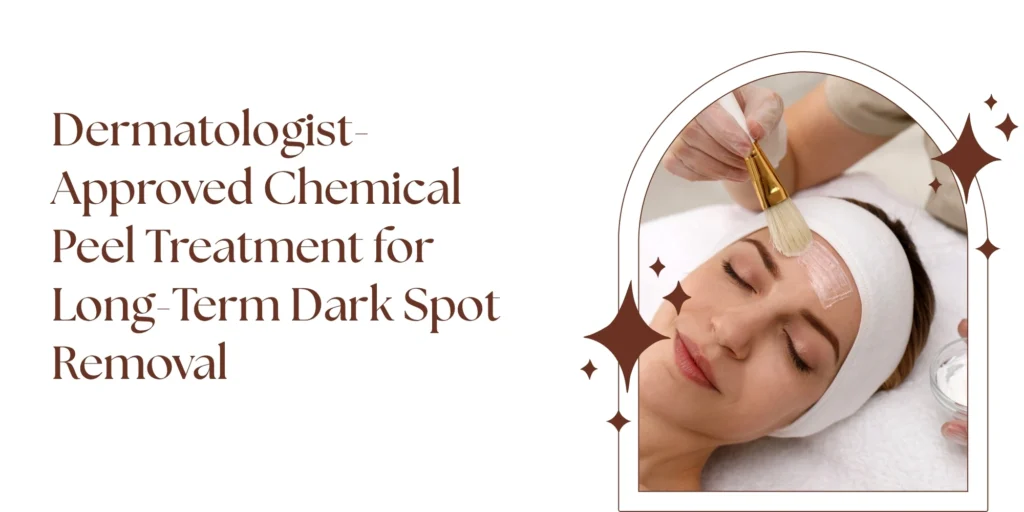
Chemical peel treatment for dark spots works by accelerating the skin’s natural cell turnover, removing the pigmented outer layers and revealing fresher, more evenly toned skin underneath. When selected and performed correctly for Indian skin, it is one of the most effective dark spot removal treatments available, addressing post-acne marks, sun-induced pigmentation, and uneven tone progressively across a structured course. At AK Dermacare in West Delhi, Dr. Parul Garg uses dermatologist-selected chemical peels calibrated specifically for darker Indian skin tones to deliver long-term pigmentation improvement without the hyperpigmentation risk that incorrectly chosen peels routinely cause. Most patients see meaningful improvement across 4 to 6 sessions.
Key Takeaways
Can chemical peel remove dark spots permanently? Chemical peels significantly and lastingly reduce existing dark spots. Whether results are permanent depends on the cause. Hormonally driven pigmentation like melasma can recur without ongoing management.
Which chemical peel is best in India for dark spots? For Indian skin, peels with mandelic acid, glycolic acid, lactic acid, salicylic acid, and low-concentration TCA are the most commonly used.
How many sessions are needed? Most patients need 4 to 6 sessions spaced 2 to 4 weeks apart for significant improvement. Deeper or more established pigmentation may need additional sessions.
What is the cost of chemical peel for dark spots? A single session in India typically ranges from INR 1,500 to INR 8,000 depending on the peel type, clinic qualification, and treatment area.
Introduction
You have been staring at the same dark spots for months. Some of them are old acne marks that refused to leave after the breakout healed. Some appeared after a summer of too much sun and not enough SPF. Some have been there so long you have forgotten what your skin looked like without them. You have tried brightening serums, vitamin C, kojic acid, and every fade cream the internet recommended. Some of them helped a little. None of them cleared the spots completely.
Topical products work on the very surface of the skin. They can slow down melanin production and mildly lighten existing pigmentation over time. But the melanin deposits responsible for visible dark spots sit in layers that most topical actives cannot reach at the concentrations present in over-the-counter products. You can improve the problem with topicals, but you rarely resolve it.
Chemical peel for dark spots works differently. It removes the pigmented layers directly, accelerating cell turnover at a depth that topical products cannot achieve, and triggering the kind of skin renewal that produces lasting pigmentation improvement rather than temporary lightening.
At AK Dermacare in West Delhi, Dr. Parul Garg has helped patients clear dark spots that topical routines alone could not resolve, through dermatologist-selected peel protocols specifically designed for Indian skin. Here is exactly how it works and what to expect.
Why Dark Spots Are Difficult to Remove With Topicals Alone
Dark spots, clinically referred to as hyperpigmentation, are areas where melanin has been overproduced and deposited in concentrated form in the skin. The trigger varies: UV exposure, post-inflammatory response after acne or injury, hormonal changes, or a combination of all three.
The problem with topical dark spot removal treatment is reach. Vitamin C, niacinamide, kojic acid, and arbutin all work by inhibiting the enzyme tyrosinase that drives melanin production. They are genuinely effective at slowing new pigmentation formation. What they do not do efficiently is remove the existing melanin deposits sitting in the stratum granulosum and upper dermis, the layers where established dark spots live.
Chemical peel treatment solves this by removing those layers directly. The acid solution applied during a peel causes controlled exfoliation of the pigmented skin layers, exposing the fresher, less pigmented skin below and simultaneously triggering cell renewal that replaces damaged melanin-laden cells with new, more evenly pigmented ones.
Which Chemical Peel for Dark Spots Works Best on Indian Skin
This is the question Dr. Parul Garg is asked most often in pigmentation consultations. The honest answer is that there is no single best peel, there is the best peel for your specific skin tone, pigmentation type, and depth.
For Indian skin specifically, peel selection carries an additional layer of clinical responsibility. Darker Fitzpatrick skin tones (III to VI) are more prone to post-inflammatory hyperpigmentation, meaning the wrong peel, applied at the wrong concentration, can cause the very problem you came in to fix. This is why dermatologist assessment before any peel is not optional for dark-skinned patients.
Mandelic acid peels: Derived from almonds, mandelic acid has the largest molecular size of the common AHAs, which means it penetrates the skin more slowly and evenly, making it the gentlest and most forgiving option for darker Indian skin. It addresses post-acne marks, mild sun pigmentation, and uneven tone with a very low risk of post-inflammatory hyperpigmentation. First-time peel patients and those with sensitive skin typically start here.
Glycolic acid peels: The most studied AHA for pigmentation, glycolic acid penetrates efficiently and delivers consistent improvement in post-acne marks and sun-induced dark spots. It is effective on Indian skin at correctly calibrated concentrations, typically 20 to 35 percent in a clinical setting, but requires more careful monitoring than mandelic acid. Works best for patients with Fitzpatrick skin types III and IV.
Salicylic acid peels: A BHA that is lipid-soluble, meaning it penetrates into the pore and addresses both pigmentation and active acne simultaneously. Particularly effective for patients whose dark spots are primarily post-inflammatory, caused by repeated acne, because it treats the pigmentation and the underlying acne driver in the same session.
Lactic acid peels: Hydrating and brightening simultaneously, lactic acid is well-tolerated on dry or sensitive darker skin types and delivers progressive improvement in uneven tone with minimal recovery time.
TCA peels at low concentration: Trichloroacetic acid at 10 to 15 percent is used for more established or deeper pigmentation that has not responded fully to AHA-based peels. Requires careful patient selection and is not a first-line option for darker skin tones without prior peel preparation.
At AK Dermacare, Dr. Parul Garg typically begins with a milder peel to assess the skin’s response and progressively increases depth across the course, a staged approach that delivers consistent results while minimizing the risk of adverse pigmentation responses on Indian skin.
Types of Dark Spots and How Chemical Peel Treatment Addresses Each
Not all dark spots respond identically to peels. Understanding your specific type sets accurate expectations:
Post-acne marks (post-inflammatory hyperpigmentation): The most common dark spot complaint in Indian patients. These respond very well to chemical peels, particularly salicylic and mandelic acid, because they are primarily superficial and caused by a resolved inflammatory event rather than ongoing hormonal activity. Most patients see significant clearing across 4 to 6 sessions.
Sun-induced pigmentation (solar lentigines): Flat, well-defined brown spots from cumulative UV exposure. Glycolic and TCA peels address these effectively. Response is strong with consistent sun protection maintained between sessions and after the course.
Melasma: The most treatment-resistant form of pigmentation because it is hormonally driven, often sits at multiple depths simultaneously, and recurs with sun exposure regardless of how well it is initially cleared. Chemical peels improve melasma meaningfully but are most effective as part of a combined protocol, peels alongside prescription topicals and rigorous photoprotection. Peels alone without hormonal management and sun protection produce temporary improvement that reverses quickly.
Age spots and generalized dullness: Respond well to a course of brightening peels, with the additional benefit of overall texture and tone improvement that accompanies the pigmentation clearing.
Dark Spot Removal Treatment: What a Session Course Looks Like
Before the first session: Dr. Parul Garg conducts a full skin assessment including Fitzpatrick skin type evaluation, pigmentation type identification, review of current skincare and medications, and a patch test to confirm skin tolerance. A pre-peel priming protocol, typically involving prescription topical retinoids and a brightening agent for 2 to 4 weeks before the first session, prepares the skin and improves peel penetration uniformity.
During each session: The skin is cleansed and degreased. The selected acid solution is applied in a controlled manner, with Dr. Parul Garg monitoring skin response continuously. Neutralization occurs at the correct endpoint. The session takes 20 to 45 minutes depending on the peel type and number of layers applied.
Between sessions: Strict sun protection, a gentle moisturizing routine, and avoidance of active skincare ingredients in the first week post-peel. A maintenance topical protocol between sessions sustains the pigmentation improvement and prepares the skin for the next session.
Across the full course: Progressive improvement is visible from session 2 onward. By sessions 4 to 5, the difference in dark spot visibility and overall skin tone evenness is typically significant and photographically measurable.
Can Chemical Peel Remove Dark Spots Permanently?
This is the question most patients want answered directly, and it deserves a direct answer.
For post-acne marks and sun-induced spots cleared through a complete peel course with proper aftercare and sun protection, the results are long-lasting and in many cases permanent for the specific spots treated. The pigmented cells that caused the visible marks have been cleared and replaced with new, evenly pigmented skin.
Whether new dark spots form depends entirely on what created the originals. If you continue to have acne, new post-inflammatory marks will form. If you continue to have unprotected sun exposure, new solar pigmentation will develop. If melasma is driven by ongoing hormonal factors, it will recur without management.
The honest framework is this: chemical peel for dark spots produces excellent long-term results when the cause is addressed alongside the treatment. Dr. Parul Garg builds every peel course at AK Dermacare around this principle, treating the visible pigmentation while managing the trigger, not just clearing the current spots and leaving the underlying driver unaddressed.
What is the Cost of Chemical Peel for Dark Spots in India
Chemical peel cost for dark spots in India varies based on several factors:
- Peel type and acid concentration: mandelic and glycolic peels cost less per session than TCA peels
- Treatment area: face only versus face and neck
- Number of sessions: single session versus a full course package
- Clinic qualification: dermatologist-led medical clinics versus beauty salons or unqualified operators
- Location: Delhi NCR clinics typically range from INR 1,500 to INR 8,000 per session
A complete course of 4 to 6 sessions should be factored into the total investment when comparing options. At AK Dermacare, chemical peel treatment cost is discussed transparently during the initial consultation, with package pricing available for full courses.
The point worth stating plainly: an incorrectly selected peel for Indian skin does not just fail to remove dark spots, it frequently creates new, more severe hyperpigmentation that takes months of additional treatment to correct. The savings from choosing a cheaper, unqualified provider for a dark spot removal treatment on Indian skin are rarely real savings. At AK Dermacare, every peel is selected and supervised by Dr. Parul Garg directly.
Why Choose AK Dermacare for Dark Spot Removal Treatment in West Delhi
Dermatologist-Selected Peels: Peel type, acid selection, and concentration at AK Dermacare are clinical decisions made by Dr. Parul Garg based on your specific Fitzpatrick skin tone, pigmentation type, and treatment history, not a one-size-fits-all approach.
Pre-Peel Priming Protocol: Dr. Parul Garg prescribes a pre-treatment skin preparation regimen before the first session to improve peel penetration and reduce the risk of post-inflammatory hyperpigmentation on Indian skin.
Staged, Safe Approach: For new patients and darker skin tones, the peel course begins conservatively and deepens progressively based on observed skin response, the approach that consistently delivers results without adverse pigmentation events.
Complete Aftercare Support: Every patient receives specific post-peel instructions, maintenance skincare guidance, and scheduled follow-ups throughout the course.
Final Thoughts
The dark spots you have been managing with serums and fade creams are not going to clear completely on their own, not because the products are useless, but because they were never designed to reach the depth where established pigmentation sits.
Chemical peel for dark spots, selected correctly and applied by a qualified dermatologist, removes that pigmentation directly, producing the kind of long-term skin tone improvement that topical products can support but cannot replicate.
At AK Dermacare in West Delhi, Dr. Parul Garg combines dermatologist expertise, correct peel selection for Indian skin, and a structured course protocol to deliver dark spot clearing that lasts. Because the spots you have been staring at for months deserve more than a temporary fix.
Frequently Asked Questions (FAQs)
1. Which chemical peel is best in India for dark spots?
The best chemical peel for dark spots on Indian skin depends on your specific skin tone, pigmentation type, and depth. Mandelic acid peels are the most commonly recommended starting point for darker Indian skin tones because of their low post-inflammatory hyperpigmentation risk. Glycolic acid peels are effective for Fitzpatrick III and IV skin tones with post-acne and sun-induced pigmentation. Salicylic acid peels are best for patients whose dark spots are driven by acne. Low-concentration TCA peels address more established pigmentation,
2. Can chemical peel remove dark spots permanently?
For post-acne marks and sun-induced dark spots, a complete course of chemical peel treatment with consistent sun protection produces long-lasting and often permanent improvement in the specific spots treated. Whether new spots form depends on whether the underlying cause, acne, sun exposure, or hormonal activity, is managed alongside treatment. Melasma requires ongoing management because hormonal recurrence is common.
3. What is the cost of chemical peel for dark spots?
In India, a single chemical peel treatment session for dark spots typically ranges from INR 1,500 to INR 8,000 per session depending on the peel type, clinic qualification, and treatment area. A full course of 4 to 6 sessions should be factored into the total investment. At AK Dermacare, cost is discussed transparently during the initial consultation with package pricing available for complete courses.
4. How many sessions of chemical peel are needed for dark spots?
Most patients need 4 to 6 sessions spaced 2 to 4 weeks apart for significant improvement in dark spots. Post-acne marks typically respond within 4 sessions. More established or deeper sun-induced pigmentation may need 5 to 6 sessions. Melasma requires additional sessions and ongoing maintenance.