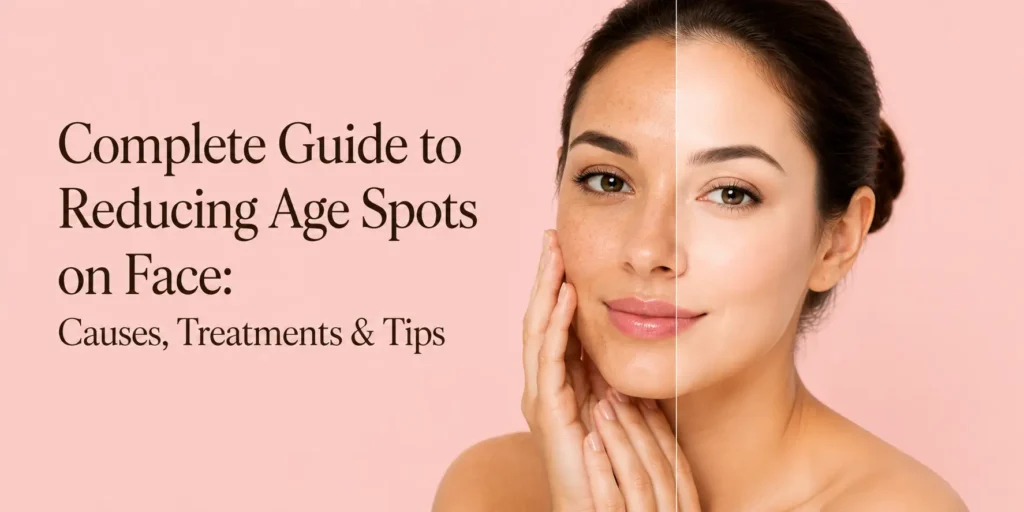
Age spots are not a sign of poor hygiene or ageing gone wrong. They are a predictable result of cumulative sun exposure interacting with melanin-producing cells that become overactive and clustered over decades. The good news is that age spots respond exceptionally well to the right combination of prevention, topical correction, and clinical treatment, more reliably than almost any other pigmentation concern. At AK Dermacare in West Delhi, Dr. Parul Garg, an experienced dermatologist in West Delhi, provides Age spot treatment in West Delhi that identifies the depth and pattern of the pigmentation before recommending a plan, because age spots that look identical on the surface can sit at very different depths in the skin.
Key Takeaways
- What causes age spots on the face? Cumulative UV exposure over decades, triggering localised overproduction and clustering of melanin, most commonly on the cheeks, forehead, temples, and backs of the hands.
- Can age spots be removed completely? In most cases, yes, with the right combination of laser treatment, peels, and topical correction. Deeper or long-standing spots may need more sessions but still show significant clearance.
- How much does age spot treatment cost in Delhi? Cost depends on treatment type, number of spots, session count, and technology used, and is typically discussed after an in-person assessment.
- How long does treatment take to work? Most patients see visible fading within 2 to 4 weeks per session, with full clearance usually needing 1 to 6 sessions depending on depth.
Introduction
Age spots, also known as solar lentigines or liver spots, are one of the most visible and most commonly misunderstood signs of skin ageing. They are frequently confused with melasma, freckles, or general sun tanning, but they are a distinct condition with a distinct mechanism, and this distinction matters significantly for treatment.
Most people notice age spots gradually: a small brown mark on the cheek that was not there a few years ago, a cluster of spots on the forehead after a summer holiday, or a patch on the back of the hand that never fully fades with brightening creams. These are not random. They are the visible result of decades of sun exposure surfacing on the skin.
Topical brightening products alone often fail to clear age spots because the melanin sits deeper than most creams can reach, and the melanocytes producing it have often become permanently more active in that specific location. Clearing age spots effectively usually requires reaching that depth directly, which is where age-spot removal treatments in Delhiat a dermatologist-led clinic outperform home remedies. At AK Dermacare, Dr. Parul Garg takes exactly this depth-first approach with every patient before recommending a treatment path.
What Are Age Spots and Why Do They Form
Age spots are flat, brown, tan, or black spots that develop on skin with years of sun exposure, most commonly the face, hands, shoulders, and forearms. Despite the name, they are not caused by age itself. They are caused by cumulative ultraviolet exposure, and age simply allows enough sun exposure to accumulate.
UV radiation stimulates melanocytes to produce more melanin as a protective response. With repeated exposure over years, certain melanocytes in specific locations become chronically overactive and produce melanin in dense, localised clusters rather than the even distribution seen in normal tanning. This clustering creates the visible, well-defined brown spot.
Age spots typically appear on:
- Cheeks, forehead, and temples
- Nose bridge
- Backs of the hands and forearms
- Shoulders
They become more noticeable from the mid-30s onward, with prevalence increasing significantly after age 40.
Age Spots vs Other Pigmentation
Getting the diagnosis right changes the entire treatment approach.
- Age spots: well-defined, round or oval, discrete individual spots, minimal hormonal component, respond predictably to laser.
- Melasma: larger, less defined, often symmetrical patches, strongly hormonally influenced, needs a conservative, multi-modal approach.
- Freckles: smaller, more numerous, often genetic, tend to fade in winter unlike age spots.
At AK Dermacare, Dr. Parul Garg distinguishes between these conditions at the initial consultation, because treating age spots with a melasma-appropriate protocol undertreats them, while treating melasma with an age-spot-appropriate protocol can worsen it.
Who Is Most Prone to Age Spots
- Fair to medium skin tones with a history of unprotected sun exposure, though darker Indian skin tones are not immune with decades of outdoor exposure.
- History of outdoor occupations or frequent travel to high-UV locations.
- Genetic predisposition toward melanocyte reactivity.
- A history of repeated sunburns, particularly in earlier decades of life.
Can Age Spots Be Removed Completely
In most cases, yes, though the degree of clearance depends on several factors. Age spots that are relatively superficial and recently developed often clear completely or nearly completely within a course of sessions.
Older, deeper, or more established spots may require more sessions and may show excellent lightening rather than complete disappearance. This reflects the depth and density of melanin accumulated over time rather than a failure of treatment.
The other critical factor is preventing recurrence. Since age spots form because of UV exposure, new spots can develop in the same areas without consistent sun protection after treatment, even though the originally treated spots remain cleared. At AK Dermacare, every treatment plan includes this maintenance conversation upfront so patients understand what long-term clearance actually requires.
Treatment Options for Age Spots
The table below summarises the main age-spot removal treatments in Delhi, all of which are available at AK Dermacare under Dr. Parul Garg’s supervision:
| Treatment | Best For | Typical Sessions | Downtime |
| Q-switched Nd:YAG / Picosecond Laser | Well-defined, discrete spots | 1 to 4 | Minimal (crusting 7–14 days) |
| Chemical Peels (TCA/Glycolic) | Multiple smaller spots, broader damage | 3 to 6 | Mild peeling, few days |
| Cryotherapy | Isolated, well-defined spots | 1 to 2 | Redness, mild white-mark risk |
| Prescription Topicals | Supporting/maintenance | Ongoing, months | None |
| IPL | Widespread, diffuse sun damage | 3 to 5 | Mild redness, 1–2 days |
Laser treatment using Q-switched Nd:YAG or picosecond lasers is the most effective and most commonly used option. Short pulses of energy are selectively absorbed by melanin in the spot, fragmenting it into particles the body clears naturally over the following weeks. Sessions are usually spaced 3 to 4 weeks apart.
Chemical peels using TCA or glycolic acid at clinical concentrations accelerate shedding of pigmented surface cells and are often combined with laser or used for patients with multiple smaller spots across a broader area.
Cryotherapy using liquid nitrogen causes pigmented cells to blister and shed, revealing lighter skin beneath. It is quick and effective for isolated spots but carries a slightly higher risk of a temporary white mark in darker skin tones.
Prescription topical treatment
With hydroquinone, retinoids, and combination brightening formulations lightens spots gradually over months and is often prescribed alongside procedural treatment to accelerate results and prevent new spots.
IPL is sometimes used for widespread sun damage across a larger area such as the chest or forearms, though it is generally less precise than Q-switched or picosecond laser for discrete spots.
At AK Dermacare, Dr. Parul Garg selects between these options, or combines several, based on how the individual spots present rather than defaulting to a single technology for every patient.
What to Expect During and After Treatment
- Sessions are quick: a few minutes for a small number of spots, up to 20 to 30 minutes for broader areas.
- Laser treatment feels like a brief snapping or stinging sensation, tolerable without anaesthesia for most patients.
- The spot often appears darker or develops a light crust (frosting) over the following days — a normal part of healing, not a complication.
- The treated spot typically flakes off within 7 to 14 days, revealing lighter skin beneath.
- Sun protection is essential during healing and afterward, since freshly treated skin is more vulnerable to UV-triggered pigmentation.
How Much Does Age Spot Treatment Cost in Delhi
The cost of age spot treatment in Delhi depends on several variables rather than a single fixed rate:
- Number of spots being treated, since pricing is often structured per spot or per area.
- Treatment modality chosen — laser for a few discrete spots vs a peel series or broader laser coverage for widespread damage.
- Number of sessions required, based on spot depth and density.
- Clinic technology and the treating dermatologist’s experience, since medical-grade lasers calibrated for Indian skin tones represent a different investment than lower-powered devices.
At AK Dermacare, the cost of age spot treatment for Age spot treatment in West Delhi is discussed transparently after an in-person assessment with Dr. Parul Garg, since an accurate quote depends entirely on the number, size, and depth of the spots present.
Preventing New Age Spots From Forming
Treatment without prevention produces only temporary results, since the same UV exposure that created the original spots will continue to create new ones.
- Daily broad-spectrum SPF 30 to 50, applied every morning and reapplied during prolonged outdoor exposure.
- Physical sun protection such as wide-brimmed hats and UV-protective clothing, especially during peak UV hours (11am–4pm).
- Antioxidant serums, particularly vitamin C in the morning, to neutralise free radical damage before it triggers melanocyte activation.
- Regular use of a gentle retinoid to support cell turnover and prevent pigmented cell accumulation.
At AK Dermacare, this prevention plan is built into every age spot treatment package, not offered as an afterthought once the procedural sessions are complete.
Why Choose an Experienced Dermatologist in West Delhi
Age spot treatment carries specific risks when performed incorrectly, particularly on Indian skin tones, which are more prone to post-inflammatory hyperpigmentation if laser settings are too aggressive or the wrong technology is selected.
An experienced dermatologist in West Delhi will first confirm the diagnosis, distinguishing age spots from melasma, freckles, or other pigmented lesions that may need a different approach entirely.
At AK Dermacare, Dr. Parul Garg calibrates laser parameters specifically to each patient’s skin tone and spot depth rather than applying a standard setting across all patients. This individualised approach produces consistent, safe clearance without the rebound pigmentation that under-qualified treatment can cause.
Final Thoughts
Age spots are one of the most treatable forms of facial pigmentation when approached correctly, and one of the most likely to recur without a prevention plan. The combination of accurate diagnosis, appropriately calibrated laser or peel treatment, and consistent daily sun protection produces the most complete and lasting results.
At AK Dermacare in West Delhi, Dr. Parul Garg provides Age spot treatment in West Delhi built around this exact combination: correct identification of the pigmentation type, a plan matched to the spot’s depth and density, and a maintenance strategy that protects results for years, not just months. For anyone comparing age-spot removal treatments in Delhi, this diagnostic-first, dermatologist-led approach is what separates a treatment that works once from one that produces lasting, natural-looking clearance.
Frequently Asked Questions (FAQs)
1. What causes age spots on the face?
Age spots are caused by cumulative ultraviolet exposure over years, which triggers localised melanocyte overactivity and clustered melanin production in sun-exposed areas like the cheeks, forehead, and temples.
2. Can age spots be removed completely?
Yes, in most cases, particularly for spots that are relatively recent or superficial. Older or long-standing spots may need more sessions and show excellent lightening rather than total disappearance, but significant improvement is achievable in nearly all cases. Dr. Parul Garg at AK Dermacare assesses each spot individually to set realistic expectations before treatment begins.
3. How much does age spot treatment cost in Delhi?
Cost depends on the number of spots, treatment type, session count, and clinic technology, and is best confirmed after an in-person assessment since every patient’s pigmentation pattern differs. At AK Dermacare, this assessment is provided upfront and transparently.
4. How long does age spot treatment take to work?
Most patients see visible fading within 2 to 4 weeks of a session, with significant to complete clearance typically within 1 to 4 sessions depending on depth and density.