
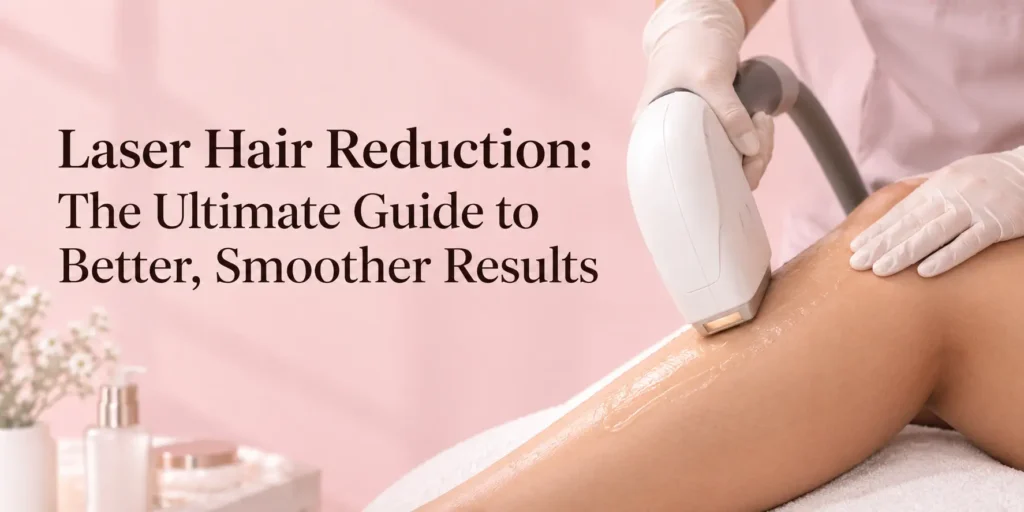
Laser hair reduction uses concentrated light to damage the follicles that produce hair, so that regrowth becomes slower, finer and sparser over a course of sessions. It is a reduction method rather than a promise of permanent removal, and results depend on the match between the device, your skin tone, your hair colour and thickness, and any hormonal factors behind the growth. The best outcomes come from a proper assessment, a full course spaced correctly, careful sun avoidance and an experienced practitioner who sets realistic expectations. At AK Dermacare in West Delhi, Dr. Parul Garg evaluates skin type, hair pattern and possible hormonal causes before designing a laser plan, because settings that suit one person can burn or underperform on another.
Key Takeaways
Is laser hair reduction permanent? It gives long-lasting reduction, typically 70 to 90 percent in suitable patients, but some hairs can return, so occasional top-ups are common.
How many sessions are needed? Most areas need 6 to 8 sessions, spaced 4 to 8 weeks apart depending on the body area.
Does it work on all skin and hair types? Modern lasers can treat a wide range of skin tones, but white, grey and very fine blonde hair respond poorly.
Is it painful? Most people describe a brief snapping or warm sensation, and cooling technology keeps it comfortable.
Introduction
Shaving, waxing, threading and creams all share one drawback: they need repeating, often every few days or weeks. Along the way come ingrown hairs, razor bumps, stubble, darkened skin and sore, irritated patches. It is no surprise that laser hair reduction has become one of the most requested cosmetic procedures.
Yet it is also one of the most misunderstood. People expect a couple of sessions to leave them permanently hairless, or assume any machine in any salon will deliver the same result. In reality, outcomes depend on biology, technology and technique. This guide explains how the treatment works, who benefits most, how to prepare, what to expect and how to get results that last.
How Laser Hair Reduction Works
The laser emits light that is absorbed by melanin, the pigment in hair. The light converts to heat, travels down the hair shaft and damages the follicle, reducing its ability to grow new hair.
The catch is timing. Hair grows in cycles, and the laser is only effective on follicles in the active growth phase (anagen), when the hair is connected to its root. At any moment, only a portion of the hairs in an area are in that phase, and the rest are resting or shedding. That is why one session cannot treat everything, and why repeated sessions are needed to catch each batch as it enters the growth phase.
This also explains why the treatment targets pigment. Dark hair against lighter skin gives the clearest contrast. As technology has improved, lasers can be tuned to treat darker skin more safely, but the principle remains the same: the target is the melanin in the hair, and the skin must be protected from absorbing too much energy.
Reduction Versus Removal: Setting Honest Expectations
You will often see the phrase “permanent hair removal in Dehi“, but regulators and specialists generally prefer “permanent hair reduction”. The distinction matters.
After a full course, many patients see a substantial fall in hair density, and the hairs that remain are usually finer, lighter and slower growing. Some follicles are permanently disabled. Others are only weakened and may recover over months or years, particularly when hormones are active. This is why maintenance sessions once or twice a year are common.
Anyone promising 100 percent, lifelong hairlessness in three sessions is overselling.
Who Is a Good Candidate?
Laser tends to work best for:
- People with dark, coarse hair on light to medium skin
- Those with darker skin tones, when treated with a suitable laser type and experienced hands
- Those troubled by ingrown hairs, razor bumps or folliculitis from shaving
- Anyone tired of the time and cost of repeated waxing or threading
- Patients whose excess hair is being managed medically alongside treatment
It is less effective or unsuitable for:
- White, grey, red or very light blonde hair, which lacks enough pigment
- Very fine, downy hair, which may respond only partially
- Recently tanned skin, which raises the risk of burns and pigment changes
- Active infections, open wounds or inflamed skin in the treatment area
Choosing the Right Laser Technology
Different devices suit different skin and hair. Your dermatologist will choose based on your skin tone, hair thickness and the body area.
| Laser type | Typically suited to | Points to know |
| Diode | A wide range of skin tones and hair types | Widely used and versatile, with good cooling systems |
| Alexandrite | Lighter skin with dark hair | Very effective and fast, less suited to darker skin |
| Nd:YAG | Darker skin tones | Deeper wavelength, safer for pigmented skin but may be less effective on fine hair |
| IPL (intense pulsed light) | Mild cases on lighter skin | Not a true laser, and generally less effective and less consistent |
The machine matters, but the operator matters more. Correct energy settings, pulse duration and cooling, together with an accurate reading of the patient’s skin, determine whether a session is safe and effective. A good device in inexperienced hands can cause burns, while a well-chosen setting in skilled hands is comfortable and productive.
Why Hormones Matter
If hair keeps returning aggressively, or grows in unusual places such as the chin, jawline, upper lip, chest or abdomen, hormones may be involved. Conditions such as polycystic ovary syndrome (PCOS) and thyroid or other endocrine disorders can drive continued growth of new terminal hairs, even in areas already treated.
In such cases, the laser alone can disappoint, since new follicles keep being stimulated. Treating the underlying condition, with medical guidance, and combining it with laser usually gives far better and more lasting results. This is one of the biggest reasons people feel laser “did not work” for them. At AK Dermacare, Dr. Parul Garg screens for these patterns during the consultation, and may suggest blood tests if the history points that way.
How to Prepare for Your Sessions
Good preparation improves comfort and safety.
- Avoid sun exposure and tanning for at least 2 to 4 weeks before each session, including tanning beds and self-tanners.
- Shave the area one day before. Shaving leaves the root intact so the laser can reach it, and avoids surface hair burning.
- Do not wax, thread, pluck or use epilators for at least 4 to 6 weeks beforehand, since these remove the root of the laser targets.
- Stop hair-bleaching and depilatory creams for a few days before.
- Tell your dermatologist about medicines, especially those that increase light sensitivity, such as certain antibiotics or isotretinoin, and any history of cold sores, keloids or pigmentation.
- Arrive with clean skin, free of creams, perfume, deodorant or makeup in the area.
What Happens During a Session
A typical session follows this pattern:
- The skin is cleaned and the area is shaved if needed.
- Protective eyewear is provided.
- A test patch may be done on the first visit to check your response.
- The handpiece is passed over the skin in small sections, delivering pulses with cooling.
- A soothing gel or cream is applied afterwards.
Small areas such as the upper lip take minutes, while legs or full back may take up to an hour. Most people feel a quick snap or flick, similar to a rubber band, and tolerate it well with cooling.
What to Expect After a Session
- Mild redness and small raised bumps around the follicles, usually settling in a few hours to a day
- A feeling of warmth, like mild sunburn, in sensitive areas
- Shedding: Treated hairs do not vanish immediately. They loosen and fall out over 1 to 3 weeks, and may look like new growth, which is normal.
Do not pluck or wax in between sessions. Shaving is fine.
Aftercare Essentials
- Use a gentle moisturiser or aloe-based soothing gel
- Avoid hot showers, saunas, steam, swimming pools and heavy exercise for 24 to 48 hours
- Do not scrub or exfoliate the area for several days
- Apply broad-spectrum sunscreen of SPF 30 or higher on exposed areas, and avoid direct sun
- Avoid perfumed products and tight, rubbing clothing on treated skin
- Never pick at crusts or bumps
How Many Sessions and How Often?
The number of sessions depends on body area, hair thickness, hormones and skin type.
| Area | Typical interval | Typical sessions |
| Face (upper lip, chin, sides) | 4 to 6 weeks | 6 to 8 or more |
| Underarms | 4 to 6 weeks | 6 to 8 |
| Arms and legs | 6 to 8 weeks | 6 to 8 |
| Bikini and intimate areas | 4 to 8 weeks | 6 to 8 |
| Back and chest | 6 to 8 weeks | 6 to 8 |
Facial hair, especially in women with hormonal causes, often needs more sessions and occasional maintenance. Spacing depends on the growth cycle of each region, since hair on the face cycles faster than on the legs. Skipping sessions or stretching intervals too far reduces effectiveness.
Safety and Possible Side Effects
Laser hair reduction is well established and safe when done properly. Most side effects are mild and short-lived: redness, swelling, tenderness and small bumps.
Less common risks include:
- Burns or blisters, usually from excessive energy or poor cooling
- Hyperpigmentation or hypopigmentation, more likely with sun exposure or unsuitable settings
- Paradoxical hypertrichosis, where fine hair grows thicker in a treated area, rare and mainly reported on the face and neck in some people
- Folliculitis or infection, if hygiene is poor
Choosing a clinic that uses proper devices, screens patients and is run by a qualified doctor lowers these risks considerably.
Who Should Postpone or Avoid It
Treatment is usually delayed or avoided if you are:
- Pregnant, where elective laser is generally deferred
- Tanned or recently sunburnt
- Using isotretinoin or other photosensitising drugs without medical clearance
- Suffering from an active skin infection, eczema flare or open sores in the area
- Prone to keloids or abnormal scarring, in which case caution is needed
Common Mistakes That Reduce Results
- Choosing the cheapest package without checking the device or operator
- Waxing or threading between sessions
- Skipping sessions or delaying too long
- Getting treated on tanned skin
- Ignoring hormonal causes of persistent growth
- Expecting full results after two or three sessions
- Stopping the course when hair “grows back a bit” midway, which is part of the process
Laser vs Other Hair Removal Methods
| Method | Effect | Downsides |
| Shaving | Immediate, temporary | Stubble, razor bumps, daily upkeep |
| Waxing and threading | Lasts a few weeks | Painful, ingrowns, pigmentation |
| Depilatory creams | Short-term | Irritation, odour, allergy |
| Electrolysis | Permanent, treats each hair individually | Slow, best for small areas |
| Laser hair reduction | Long-lasting reduction | Needs a course, not for all hair colours |
For large areas such as legs, back or underarms, laser is generally the most practical choice. For small numbers of white or light hairs, electrolysis may be suitable.
Why an Experienced Dermatologist Matters
Laser is not simply a matter of pointing a machine at hair. A dermatologist understands skin biology, can distinguish normal hair growth from hormonal patterns, chooses settings that respect your skin tone and can manage any reaction that occurs. This matters most for Indian and other medium to deep skin tones, where safe energy levels sit close to the threshold for pigment changes.
At AK Dermacare, Dr. Parul Garg assesses skin type, hair characteristics and medical history before starting, tailors settings to each area and adjusts the plan as your hair responds, so you get smoother results with fewer risks.
Final Thoughts
Laser hair reduction can transform daily routines, cutting down on shaving, ingrowns and irritation, but it delivers its best results when treated as a planned medical procedure rather than a quick cosmetic fix. Suitable candidates, the right device, a complete course, good preparation, sun avoidance and attention to hormonal causes together make the difference between patchy, disappointing outcomes and genuinely smoother skin.
At AK Dermacare in West Delhi, Dr. Parul Garg builds every laser plan around your skin, your hair and your goals. If you are considering laser, a consultation is the best first step towards results that are safe, realistic and lasting.
Frequently Asked Questions (FAQs)
1. Is laser hair reduction permanent?
It provides long-lasting reduction, and some follicles are permanently disabled, but others can recover, especially with hormonal influences. Many patients need occasional maintenance sessions after the main course.
2. How many laser sessions do I need?
Most people need 6 to 8 sessions spaced 4 to 8 weeks apart, depending on the area. Hormonal or very stubborn hair may need more.
3. Does laser hair reduction hurt?
Most people feel a brief snapping or warm sensation, with cooling making it comfortable. Sensitive areas such as the upper lip and bikini line may feel sharper, and numbing cream can help in some cases.
4. Can laser be done on dark or Indian skin?
Yes, with suitable devices such as diode or Nd:YAG and appropriate settings, performed by an experienced practitioner. Poor technique on deeper skin tones raises the risk of burns and pigment changes.
5. Can I shave between sessions?
Yes. Shaving is fine and encouraged. Avoid waxing, threading and plucking, since these remove the roots the laser needs to target.
6. Why is hair growing back after a laser?
Regrowth may be due to hairs that were not in the active phase during treatment, follicles that were only weakened, or hormonal conditions that stimulate new growth. A proper assessment can identify the cause.