Adult acne treatment in Delhi for women is a clinically distinct challenge from teenage acne because the triggers, the hormonal context, and the skin’s capacity for recovery are all different. Women in their 20s, 30s, and 40s experiencing persistent or cyclical breakouts are not dealing with the same skin condition as an adolescent, and treating it the same way produces the same disappointment most of them have already experienced. At AK Dermacare in West Delhi, Dr. Parul Garg approaches women’s acne treatment in West Delhi by identifying the specific hormonal, dietary, topical, and lifestyle triggers driving each patient’s acne before prescribing any treatment.
Key Takeaways
What causes adult acne in women? A combination of hormonal fluctuations, sebum overproduction, follicular plugging, and bacterial activity, most commonly driven by androgen excess, PCOS, cyclical estrogen decline, stress, and comedogenic skincare products.
Is adult acne in women different from teenage acne? Yes. Adult female acne tends to be hormonal, cyclical, located on the lower face and jawline, and more prone to inflammatory nodules rather than surface comedones.
What skincare routine is best for acne-prone skin? A non-comedogenic, dermatologist-prescribed routine with a gentle cleanser, topical retinoid or prescribed active, a lightweight non-comedogenic moisturiser, and SPF every morning.
Can adult acne be permanently resolved? With correct diagnosis, appropriate prescription treatment, and trigger management, adult acne in women can be very effectively controlled and, for many patients, completely cleared.
Introduction
Adult acne is one of the most frustrating skin conditions a woman can experience, and partly because it is not supposed to happen. Acne is what teenagers get. By the late 20s or 30s, the skin is supposed to have settled. When it has not, and when the breakouts continue on the chin, the jawline, and the lower cheeks through adulthood, the frustration is compounded by the feeling that something must be fundamentally wrong.
Something is, but it is rarely what most women assume. Adult acne in women is not caused by bad hygiene or poor diet alone. It is not caused by the wrong cleanser. In the majority of cases, adult female acne has a hormonal driver, a persistent overactivation of sebaceous glands by androgens or a cyclical collapse in estrogen that allows androgen effects to dominate in the luteal phase of the menstrual cycle.
This is why the over-the-counter benzoyl peroxide wash worked a little but never cleared it. Why the salicylic acid serum helped at the surface but did not stop the deep, painful nodules. This is why, for many women, the breakouts follow the calendar of their cycle with frustrating predictability.
At AK Dermacare, the best acne treatment clinic West Delhi, Dr. Parul Garg addresses adult female acne from the correct starting point: identifying what is actually driving it before prescribing a single product or performing a single treatment.
Why Adult Acne in Women Is Different
Adult female acne has a distinct clinical profile that separates it from adolescent acne in several important ways:
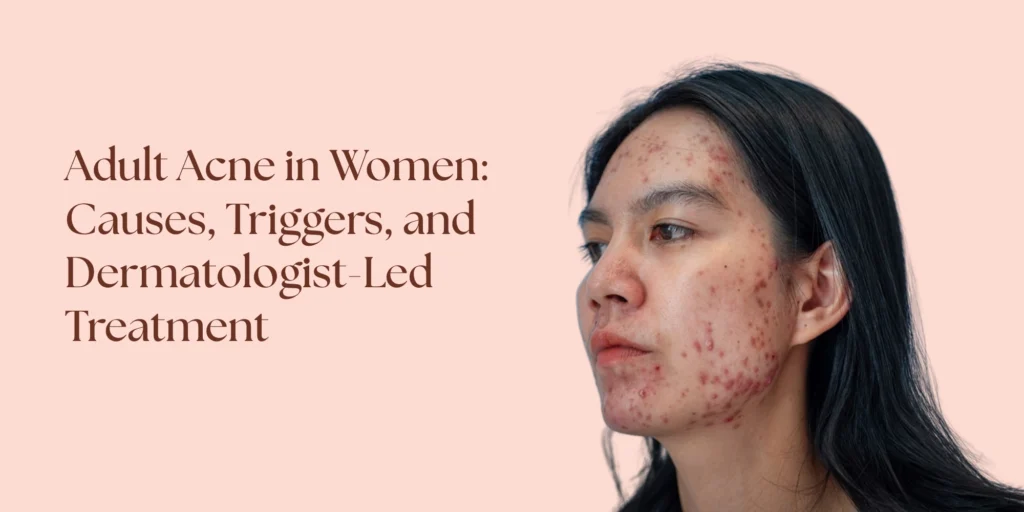
Location: Adult female acne clusters on the lower face: the jawline, chin, and lower cheeks. This is the androgen-sensitive zone of the face where sebaceous glands are most responsive to hormonal stimulation. Teenage acne typically distributes across the T-zone and full face.
Type of lesion: Adult female acne tends to produce deeper, inflammatory nodules and cysts rather than the surface comedones and pustules of adolescent acne. These deeper lesions are more painful, take longer to resolve, and leave more significant post-inflammatory pigmentation and scarring.
Cyclical pattern: In hormonally driven adult female acne, breakouts reliably worsen in the 7 to 10 days before menstruation when progesterone rises and estrogen declines, allowing androgens to dominate sebaceous gland activity.
Skin context: Adult skin has lower collagen density, less resilience, and less rapid cell turnover than teenage skin, meaning post-inflammatory hyperpigmentation and acne scarring from adult breakouts are more persistent and more significant.
Trigger complexity: Adult female acne involves a more complex set of triggers, including hormonal conditions, stress-related cortisol elevation, dietary factors, skincare product comedogenicity, and medication effects that require systematic assessment rather than generic acne treatment.
What Causes Adult Acne in Women
Hormonal Drivers
Androgens and sebum overproduction: Androgens, particularly testosterone and its active derivative DHT, directly stimulate sebaceous glands to overproduce sebum. Excess sebum combines with dead skin cells to plug follicles, creating the anaerobic environment in which Cutibacterium acnes bacteria proliferate and produce the inflammatory response that results in acne.
PCOS (Polycystic Ovary Syndrome): One of the most common causes of persistent adult acne in women. PCOS produces elevated androgen levels that continuously stimulate sebaceous glands, which is why acne in PCOS patients does not respond to topical treatment alone without addressing the underlying hormonal condition.
Cyclical hormonal fluctuation: Even in women without PCOS, the natural rise in progesterone and relative decline in estrogen in the luteal phase (days 15 to 28 of the cycle) creates cyclical androgen-dominant conditions that produce the predictable pre-menstrual breakout pattern most women with hormonal acne recognise.
Stress and cortisol: Cortisol, the primary stress hormone, directly stimulates androgen production and sebaceous gland activity. Chronic stress is one of the most consistent aggravating factors in adult female acne and a reason breakouts worsen during high-stress periods regardless of skincare routine.
Perimenopause: The hormonal instability of the perimenopausal transition, characterised by fluctuating and declining estrogen with relative androgen excess, frequently triggers or worsens acne in women in their 40s who may have had clear skin for years.
Non-Hormonal Triggers
Comedogenic skincare and makeup: Many moisturisers, foundations, sunscreens, and hair products contain ingredients that plug follicles in acne-prone skin. Silicones, heavy emollients, and certain mineral oils are common offenders that maintain a breakout cycle that would otherwise resolve.
Diet: High glycaemic index diets produce insulin spikes that elevate insulin-like growth factor 1 (IGF-1), which directly stimulates sebaceous gland activity and androgen production. Dairy, particularly skim milk, has an established association with acne in susceptible individuals through similar IGF-1 mechanisms.
Medication-induced acne: Certain medications including lithium, corticosteroids, some antiepileptics, and high-dose B12 supplementation can trigger or worsen acne. A complete medication review is part of the assessment at AK Dermacare.
Maskne and mechanical acne: Friction, pressure, and occlusion from masks, chin straps, phone contact, and hair on the face are recognised acne triggers in adult women, particularly for the lower face and jawline.
Dermatologist Recommended Acne Skincare Routine
The right skincare routine for acne-prone adult female skin is not the most aggressive routine. It is the most precisely calibrated one. Over-stripping the skin barrier with harsh cleansers and excessive active layering is one of the most common reasons adult acne patients experience persistent irritation, barrier disruption, and worsening breakouts.
Morning routine for acne-prone adult skin:
- Gentle, non-foaming or low-foam cleanser that does not strip the skin barrier
- Niacinamide serum for sebum regulation, pore tightening, and anti-inflammatory effect
- Lightweight, non-comedogenic, oil-free moisturiser
- SPF 50 non-comedogenic mineral or hybrid sunscreen, every morning without exception
Evening routine:
- Gentle cleanser
- Prescription topical as directed by dermatologist: topical retinoid (tretinoin or adapalene) on non-active nights; topical antibiotic or benzoyl peroxide on active lesion nights as prescribed
- Lightweight non-comedogenic moisturiser to support the skin barrier during retinoid use
What to avoid:
- Physical scrubs and harsh manual exfoliants that create micro-tears and spread bacterial infection
- Layering multiple active ingredients without dermatologist guidance
- Comedogenic makeup and SPF products: check labels for non-comedogenic designation
- Picking and manual extraction of lesions, which drives post-inflammatory hyperpigmentation and scarring significantly
Best Dermatologist-Led Treatment for Adult Acne in Women in Delhi
At AK Dermacare, adult acne dermatologist in West Delhi Dr. Parul Garg delivers a complete, structured treatment protocol that addresses both the active acne and the post-acne consequences simultaneously.
Prescription topicals: Tretinoin, adapalene, topical clindamycin, azelaic acid, and benzoyl peroxide in dermatologist-prescribed combinations tailored to the patient’s acne type, skin tolerance, and hormonal pattern. Generic over-the-counter products do not deliver the correct concentrations or combinations for adult female acne.
Oral prescription treatment when indicated: Oral antibiotics for moderate to severe inflammatory acne as a short course to reduce bacterial load while topical and hormonal management takes effect. Oral isotretinoin for severe or scarring acne under full dermatologist supervision. Spironolactone or hormonal management options for women with confirmed androgen excess or PCOS-driven acne.
Chemical peels: Salicylic acid and glycolic acid peels reduce comedone formation, surface sebum, and post-inflammatory pigmentation while improving skin texture. Performed as a course at AK Dermacare in combination with prescription topical management.
Laser toning: Q-switched Nd:YAG laser toning reduces sebaceous gland activity, improves post-acne pigmentation, and supports overall skin clarity. Particularly effective for the post-inflammatory hyperpigmentation that adult female acne leaves behind on Indian skin.
Carbon laser facial (Hollywood Peel): A carbon lotion photosensitised laser treatment that deeply cleanses pores, reduces sebum production, and improves skin texture with zero downtime. Used both as an active acne management tool and as a maintenance treatment between prescription courses.
Acne Scars and Post-Inflammatory Pigmentation
Adult female acne leaves two distinct types of aftermath that require separate treatment consideration: post-inflammatory hyperpigmentation (PIH) and acne scars.
Post-inflammatory hyperpigmentation is the flat, dark mark left at the site of a healed acne lesion. On Indian skin, these marks are darker, more persistent, and more visible than on lighter skin tones. They are not true scars but can take 6 to 18 months to fade without treatment. Laser toning, prescription brightening topicals, and chemical peels clear PIH significantly faster.
Acne scars are structural changes to the dermis produced by the inflammatory destruction of collagen during active acne lesions. Common types in adult female acne include:
- Ice pick scars: Deep, narrow, punched-out scars that extend into the dermis
- Boxcar scars: Wider, flat-based depressions with defined edges
- Rolling scars: Wave-like undulations caused by fibrotic tissue bands pulling the skin surface downward
Acne scar treatment at AK Dermacare uses microneedling radiofrequency, fractional laser resurfacing, subcision for rolling scars, and combination protocols depending on scar type and depth. Scar treatment requires multiple sessions beginning only after the active acne is sufficiently controlled, which is why treating active acne first is always the clinical priority.
Why Choose AK Dermacare as the Best Acne Treatment Clinic West Delhi
Hormonal Assessment as Standard: Dr. Parul Garg includes a thorough hormonal history and, where indicated, appropriate investigation referral for PCOS or androgen excess as part of the initial adult female acne assessment. Women whose acne is driven by an undiagnosed hormonal condition will not achieve lasting results without addressing that underlying driver.
Complete Treatment, Not Isolated Products: Adult female acne at AK Dermacare is managed with a complete prescription topical protocol, clinical sessions, dietary guidance, and trigger identification rather than a single product recommendation.
Indian Skin Expertise: Every prescription and clinical decision at AK Dermacare accounts for the specific characteristics of Fitzpatrick III to V Indian skin, including the higher PIH risk, the stronger sebaceous gland response to androgens, and the greater tendency toward scarring from inflammatory lesions.
Active Acne and Post-Acne Management Together: Dr. Parul Garg addresses post-inflammatory hyperpigmentation and scarring as part of the treatment plan from the beginning, not as a separate concern to be addressed after the acne is eventually controlled. For adult women whose daily confidence is affected by both active breakouts and visible marks, this integrated approach produces faster, more complete results.
Final Thoughts
Adult acne in women is not a teenage problem that has not been outgrown. It is a distinct clinical condition driven by hormonal biology, lifestyle triggers, and a skin environment that is different from adolescent skin in every important way.
Adult acne treatment in Delhi that works starts with understanding what is actually driving the acne in that specific woman, the hormonal pattern, the triggers, the skin type, and the severity of both active lesions and post-acne aftermath. It then delivers a complete prescription protocol that addresses every layer of the problem rather than a generic regimen that treats the surface and leaves the biology unchanged.
At AK Dermacare in West Delhi, Dr. Parul Garg provides exactly this level of assessment, personalisation, and clinical depth for every woman with adult acne. Because the right treatment for adult female acne is not more products. It is the correct diagnosis, the correct prescription, and a dermatologist who understands that clear skin at any age is not just cosmetic. It is profoundly personal.
Frequently Asked Questions (FAQs)
1. What is the best dermatologist-led treatment for adult acne in women in Delhi?
The most effective approach is a complete, dermatologist-designed protocol that includes prescription topicals (tretinoin, topical antibiotics, azelaic acid, or benzoyl peroxide combinations calibrated to acne type), clinical sessions including chemical peels and laser toning, and hormonal assessment for women with cyclical or PCOS-driven acne. At AK Dermacare, Dr. Parul Garg assesses the full hormonal and trigger context before prescribing any treatment, which is what separates a protocol that clears acne from one that manages it at the surface.
2. What skincare routine is best for acne-prone skin in adult women?
Morning: gentle cleanser, niacinamide serum, lightweight non-comedogenic moisturiser, SPF 50 non-comedogenic sunscreen. Evening: gentle cleanser, dermatologist-prescribed topical (retinoid or antibiotic-benzoyl peroxide combination as directed), lightweight non-comedogenic moisturiser. Avoid physical scrubs, fragrance, comedogenic makeup and SPF, and picking at lesions. Prescription actives in the correct concentration and combination produce significantly better results than over-the-counter alternatives.
3. How are acne scars and post-inflammatory pigmentation treated?
Post-inflammatory hyperpigmentation (flat dark marks) is treated with laser toning, prescription brightening topicals, and chemical peels, producing faster clearance than waiting for natural fading. Structural acne scars (ice pick, boxcar, rolling) require microneedling radiofrequency, fractional laser resurfacing, or subcision depending on type and depth, with multiple sessions beginning only after active acne is controlled.
4. How do I know if my acne is hormonal?
Key indicators of hormonal adult female acne include: breakouts concentrated on the jawline, chin, and lower cheeks; worsening in the 7 to 10 days before menstruation; association with PCOS diagnosis or symptoms such as irregular cycles, excess facial hair, or weight changes; onset or worsening with hormonal contraceptive changes; and persistence or onset after the age of 25 without prior adolescent acne. Dr. Parul Garg at AK Dermacare assesses hormonal patterns at the initial consultation and incorporates this into the treatment plan.