
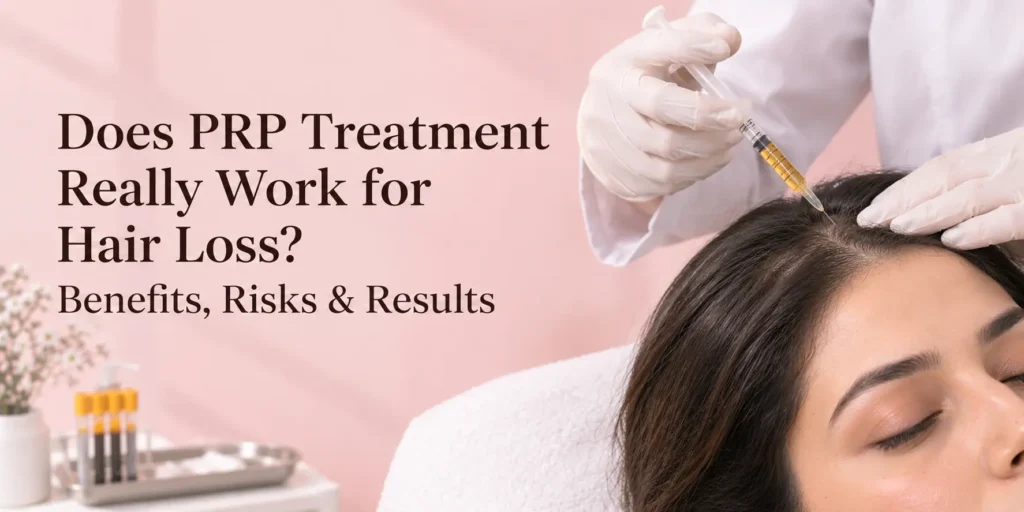
PRP (platelet-rich plasma) can work for hair loss, but not for every kind of hair loss and not for every person. The best evidence supports its use in androgenetic alopecia (pattern hair thinning), where several studies and reviews report improvements in hair density and thickness. It works by stimulating weakened but living follicles, so it cannot regrow hair where follicles are gone. Results vary with the cause, the stage, the preparation method and the injection technique, and there is no standard worldwide protocol yet. The risks are generally small and short-lived when the procedure is done in a proper clinical setting. At AK Dermacare in West Delhi, Dr. Parul Garg first diagnoses the type of hair loss, then advises whether PRP, medication or a combination is likely to help.
Key Takeaways
Does PRP work? It often does for early to moderate pattern thinning, mainly by thickening miniaturised hairs and improving density. It is far less useful for scarring hair loss or long-established bald areas.
Is it safe? Yes for most healthy adults. Side effects are typically mild, such as scalp tenderness, redness or a mild headache.
How many sessions? Commonly 3 to 4 sessions about 4 to 6 weeks apart, then maintenance every few months.
When will I see results? Changes in shedding may appear in weeks, with visible improvement usually from 3 to 6 months.
Is it permanent? No. If the underlying cause continues, thinning can progress again without maintenance.
Introduction
Few hair treatments divide opinion like PRP. Some people describe it as the best thing they did for their hair. Others spent a lot of money and saw little change. Both experiences are real, and the difference usually comes down to who was treated, for what, and how.
PRP is neither a miracle nor a gimmick. It is a legitimate, biologically plausible treatment with a growing body of research behind it, and also one where results depend heavily on selecting the right patient. This guide looks at what PRP is, what the evidence actually shows, the benefits and risks, what results are realistic and how to judge whether it is worth trying for you.
What Is PRP and How Is It Made?
PRP is a concentrate of platelets taken from your own blood. A small sample, usually drawn from the arm, is spun in a centrifuge so that the blood separates into layers. The layer rich in platelets is collected and injected into the scalp.
Platelets are best known for clotting, but they also store growth factors, signalling proteins that help the body repair tissue and regulate cell activity. Those thought to be relevant to hair include platelet-derived growth factor, vascular endothelial growth factor, epidermal growth factor and insulin-like growth factor. Because the material comes from you, allergic reactions are uncommon.
How PRP May Help Hair Follicles
In pattern hair loss, follicles gradually shrink (miniaturise). The growth phase shortens, the resting phase lengthens and each new hair is finer than the last. PRP is thought to help in several ways:
- Extending the growth phase, so hairs have longer to grow and thicken
- Encouraging resting follicles to re-enter active growth
- Improving blood supply around the follicle
- Supporting the survival and activity of the cells that build hair
The important phrase is “existing follicles”. PRP strengthens what you have. It does not create new follicles, and it cannot revive follicles that have been destroyed.
Does PRP Really Work? What the Evidence Suggests
The honest answer is “often, but with caveats”.
Several clinical studies and systematic reviews report that PRP can increase hair density and hair count and improve hair thickness in androgenetic alopecia, compared with baseline or with placebo injections. Improvements have been reported in both men and women. At the same time:
- Studies use different methods for preparing PRP, different platelet concentrations, different numbers of sessions and different intervals, so results are hard to compare.
- Many trials are small and short, and some lack strong controls.
- Outcomes are measured differently, from hair counts to photographs to patient satisfaction.
- Response varies widely between individuals.
The fair conclusion is that PRP is a reasonable option with encouraging evidence in pattern hair loss, but its effect size is modest to moderate rather than dramatic, and better-standardised research would help. For other causes of hair loss, such as alopecia areata, the evidence is weaker and mixed, and PRP is not a first-line choice.
Be wary of any clinic that presents PRP as guaranteed. Be equally sceptical of blanket claims that it does nothing. The truth depends on the patient.
The Benefits of PRP for Hair Loss
When it is a good match, PRP offers several practical advantages:
- Uses your own blood, which lowers the chance of rejection or allergy
- Non-surgical, with no incisions or stitches
- Minimal downtime, since most people resume normal activities the same day
- Can be combined with medication such as minoxidil, or with other treatments
- Useful when medication alone is not enough, or for people who prefer to lean less on tablets or topical products
- May improve hair quality, with thicker, stronger strands and less shedding
It is worth being clear about what PRP does not offer: it will not reverse advanced baldness, and it is not a substitute for a hair transplant in areas where follicles are gone.
Who Is Most Likely to Respond
PRP tends to give the best results in:
- Early to moderate androgenetic alopecia in men and women
- People whose parting is widening or whose density is dropping, but who still have visible thin hairs
- Diffuse thinning after stress, illness or hormonal change, once the trigger is being corrected
- Patients whose hair loss has plateaued on medication and who want additional support
- Those looking to maintain hair after a transplant, under specialist advice
It is generally less effective for:
- Smooth, shiny areas that have been bald for many years
- Scarring (cicatricial) alopecia, where follicles are destroyed
- Hair loss driven by an uncorrected cause such as iron deficiency, thyroid disease or a crash diet
- Very advanced pattern loss
Who Should Not Have PRP, or Should Wait
A dermatologist may advise against or postpone PRP if you have:
- A blood disorder, low platelet count or clotting problem
- An active scalp infection or inflammatory scalp disease
- Blood-thinning medication that cannot safely be adjusted
- Certain autoimmune or systemic illnesses
- An active cancer or recent cancer treatment, which needs specialist clearance
- Pregnancy or breastfeeding, when elective procedures are generally deferred
- Recent significant illness, where the timing needs review
Sharing your full medical history and medication list before treatment is part of doing PRP safely.
Risks and Side Effects
PRP is generally well tolerated, and side effects are usually mild and temporary:
- Scalp tenderness or tightness for several hours
- Redness or slight swelling
- Mild headache
- Pinpoint bleeding at injection sites
- Occasional bruising
Less common risks include infection if sterile technique is not followed, and, rarely, injury or discomfort from a poorly performed injection. Some people notice a temporary increase in shedding a few weeks after starting, as weaker hairs make way for new growth. This is usually transient, but tell your dermatologist if it worries you.
Because PRP uses your own blood, disease transmission is not a concern as long as the kit and blood handling are properly single-use and labelled. That is why the setting and the hygiene standards of the clinic matter.
What Happens During a PRP Session
- Consultation and scalp check. Your dermatologist confirms the diagnosis and that you are a suitable candidate.
- Blood draw. A small sample is taken from the arm, like a routine blood test.
- Processing. The blood is spun in a centrifuge to concentrate the platelets.
- Preparation of the scalp. The area is cleaned and can be numbed or cooled.
- Injections. The PRP is delivered into the thinning areas at the appropriate depth and spacing.
- Aftercare instructions. You go home the same day.
A session usually takes 30 to 60 minutes. Most people describe brief pricks and pressure rather than significant pain.
Sessions, Timeline and Realistic Results
| Stage | What you may notice |
| Weeks 2 to 6 | Shedding may reduce, or a brief increase may occur before settling |
| Months 2 to 3 | Fine hairs begin to look thicker, some baby hairs appear |
| Months 4 to 6 | More visible improvement in density and coverage |
| Months 6 to 12 | Peak effect after a completed course |
| Ongoing | Maintenance sessions to hold the gains |
A typical plan is 3 to 4 sessions spaced 4 to 6 weeks apart, followed by top-ups every 4 to 6 months depending on your response. Because hair grows only about a centimetre a month, patience is essential. Take photographs in the same light and angle before starting and at each visit, since memory is an unreliable judge of gradual change.
What is realistic? Most responders see thicker hairs, reduced shedding and better coverage. Very few see a full return to teenage density. Setting expectations at this level is what keeps patients satisfied.
Why Some People Feel PRP “Did Not Work”
When PRP disappoints, the reasons are usually one or more of these:
- Wrong diagnosis. The hair loss was not the type PRP helps, such as scarring alopecia or an untreated deficiency.
- Advanced loss. Too few active follicles remained to respond.
- Unaddressed cause. Iron, vitamin D, B12, thyroid or hormonal problems were never checked.
- Too few sessions. A single injection rarely gives a fair test.
- Poor technique or preparation. Inadequate platelet concentration or incorrect depth can reduce the effect.
- No maintenance. Gains fade if the underlying tendency continues unchecked.
- Unrealistic expectations. Hoping for a transplant-like result from an injection-based treatment.
What Can Improve Your Results
PRP works best as part of a wider plan:
- Investigate the cause. Basic blood tests, where indicated, can pick up correctable deficiencies or thyroid problems.
- Add medication when appropriate. Pattern hair loss is ongoing, so options such as topical minoxidil or other prescribed treatments can help maintain the gain.
- Treat scalp conditions. Dandruff or inflammation makes for a poor growing environment.
- Eat well. Adequate protein, iron and micronutrients support the growth cycle, and crash diets are a known trigger for shedding.
- Avoid smoking, which affects circulation and hair health.
- Manage stress and sleep, since both influence shedding.
- Complete the course and keep to the maintenance schedule.
PRP Compared With Other Options
| Option | How it works | Points to consider |
| Minoxidil | Prolongs the growth phase and thickens hairs | Needs continuous use, can cause initial shedding or irritation |
| Oral medication | Targets hormonal drivers in selected patients | Needs medical assessment and monitoring |
| PRP | Uses your own growth factors to stimulate follicles | Needs a course and maintenance, evidence is encouraging but variable |
| Hair transplant | Relocates follicles to bald areas | Surgical, best for established loss with adequate donor hair |
| Supplements | Corrects deficiencies | Helpful only when a deficiency exists |
These are not competitors so much as tools. Many patients get the best outcome from combining two or more, with a dermatologist deciding the mix.
Common Myths About PRP
“PRP regrows hair on a bald scalp.” It cannot revive follicles that are gone.
“It works the same for everyone.” Age, cause, stage, hormones and lifestyle all influence response.
“One session is enough.” Most people need a course plus periodic maintenance.
“It is permanent.” Without ongoing care, the underlying tendency to thin continues.
“It is painful and risky.” Most people find it tolerable, and serious complications are rare in proper hands.
“A higher price means a better result.” Diagnosis, preparation and technique matter more than the label.
How to Choose a Clinic
Before you commit, ask:
- Who will perform the procedure, and are they a qualified dermatologist?
- Will my hair loss be diagnosed first, or will PRP be offered to everyone?
- Is a closed, single-use kit used for each patient?
- How many sessions are likely to be needed, and what is the maintenance plan?
- Will progress be tracked with photographs or trichoscopy?
- Am I being given a candid discussion of limits, rather than a guarantee?
Be cautious of clinics that skip the consultation, promise fixed percentages of regrowth or push large prepaid packages.
Why Diagnosis Comes First
Two people can both complain of “hair fall treatment in west delhi” and need very different care. One may have pattern thinning, another telogen effluvium after a fever, a third iron deficiency, and a fourth a scalp condition that must be settled before any injection. PRP given without sorting this out is likely to underperform.
At AK Dermacare, Dr. Parul Garg examines the scalp, assesses the pattern and stage of loss, orders relevant tests when needed and explains what PRP can and cannot do in your case before treatment begins. That upfront honesty is the best predictor of a result you will be happy with.
Final Thoughts
So, does PRP really work for hair loss? For the right patient, with early to moderate pattern thinning and living follicles, it can meaningfully improve density, thickness and shedding, with a good safety profile and little downtime. For the wrong patient, or when used without treating the cause, it can be an expensive disappointment. The difference lies in accurate diagnosis, good technique, a complete course, sensible maintenance and realistic expectations.
At AK Dermacare in West Delhi, Dr. Parul Garg evaluates the type, stage and cause of your hair loss before recommending PRP or any other option, so that your plan is built around your scalp rather than a standard package. If you are weighing PRP, a consultation is the best first step.
Frequently Asked Questions (FAQs)
1. Does PRP really work for hair loss?
It can, particularly in early to moderate pattern hair loss where follicles are weakened but still active. Studies report improvements in density and thickness, though results vary and protocols are not standardised. It is much less effective in scarring hair loss or long-standing bald areas.
2. Is PRP safe?
For most healthy adults, yes. It uses your own blood, and side effects are usually mild, such as tenderness, redness or a mild headache. Safety depends on sterile technique and proper patient selection.
3. How many PRP sessions will I need?
Usually 3 to 4 sessions, 4 to 6 weeks apart, followed by maintenance every 4 to 6 months. The exact plan depends on the cause and stage of your hair loss.
4. How long before I see results?
Reduced shedding may come first, with visible thickening typically from around 3 months and fuller results by 6 to 12 months.
5. Are the results permanent?
Not on their own. If the underlying cause continues, thinning can progress again, so maintenance and supportive treatment are often needed.
6. Can PRP be combined with other treatments?
Yes. It is often combined with medication, scalp treatment and correction of nutritional or hormonal issues, and this usually gives better results than any single approach.
7. Who should avoid PRP?
People with blood disorders, active scalp infections, certain autoimmune or systemic conditions, those on blood thinners that cannot be adjusted, and those who are pregnant or breastfeeding may need to avoid or postpone it. Your dermatologist will review your history first.