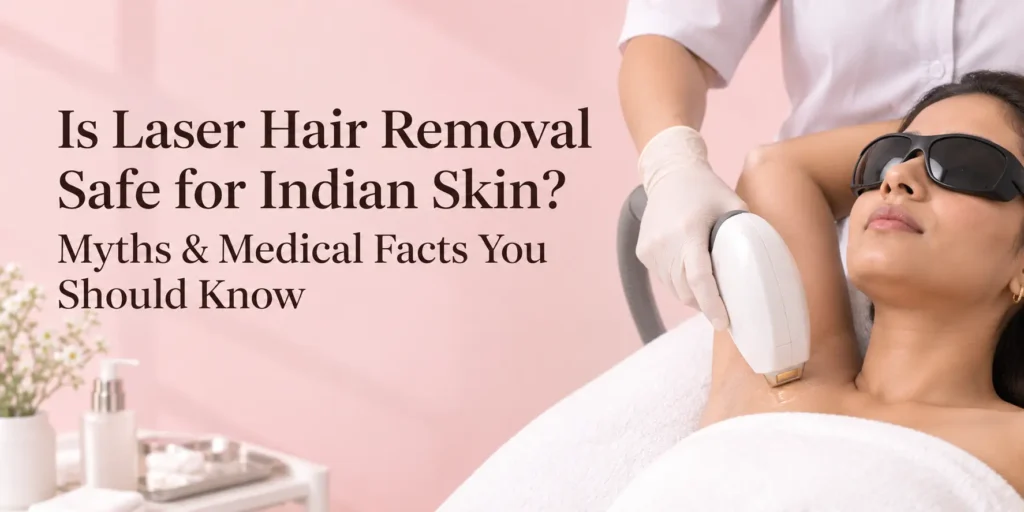
Yes, laser hair removal can be done safely on Indian skin, but only with the right device, conservative settings and an experienced practitioner. Indian skin typically falls in the medium-brown to deep-brown range (Fitzpatrick types III to V), which means it contains more melanin. The laser targets the melanin in hair, but skin melanin also absorbs some of that energy, so the margin for error is narrower than on fair skin. Most horror stories about burns, dark patches and “hair growing back thicker” come from wrong machines, aggressive settings, treatment on tanned skin or poor aftercare, not from the technology itself. At AK Dermacare in West Delhi, Dr. Parul Garg assesses skin tone, hair type, tanning and hormonal history before choosing a laser and settings, because safe treatment on Indian skin is a matter of individual calibration.
Key Takeaways
Is laser hair removal safe for Indian skin? Yes, when performed with a suitable laser (such as long-pulse Nd:YAG or a diode with good cooling) by a trained medical professional.
What is the main risk? Pigment changes, either darkening (hyperpigmentation) or lightening (hypopigmentation), usually from excess energy, tanned skin or sun exposure after treatment.
Does it cause cancer or infertility? No evidence supports either claim. The lasers used for hair reduction use non-ionising light.
Can it be done in summer? Yes, if you avoid tanning and follow strict sun protection, though many people find it easier to start in cooler months.
Introduction
Ask ten people in India about laser hair removal in Delhi and you will hear ten different opinions. One friend swears by it. A cousin ended up with dark patches. A neighbour heard it causes cancer. An online forum insists it only works on fair skin. With so much conflicting information, it is understandable that many people hesitate.
Most of the fear comes from a real kernel: laser technology was originally developed and tested mostly on lighter skin, and early machines did cause problems on darker tones. Technology has moved on significantly, but the lesson has stayed relevant. Skin tone matters, and the choice of laser and the skill of the operator matter even more. This guide separates myth from medical fact so you can decide with clear information.
Why Indian Skin Needs Special Consideration
Laser hair removal works on a principle called selective photothermolysis. The laser emits light of a particular wavelength that is absorbed by melanin in the hair, turning to heat that damages the follicle. The ideal scenario is dark hair on pale skin, where the hair absorbs nearly all of the energy and the skin absorbs very little.
Indian skin changes that equation. Because the skin itself holds a good amount of melanin, some laser energy is absorbed by the epidermis as well. If the energy is too high, the pulse is too short or the cooling is inadequate, the skin heats up along with the hair. That can lead to burns, blistering or pigment disturbance.
Indian skin also has a strong tendency toward post-inflammatory hyperpigmentation. Any irritation or injury, even a mild one, can leave a dark mark that lingers for weeks or months. This is why the same laser setting that is perfectly safe on one person can be risky on another, and why “one setting fits all” clinics are best avoided.
Myths vs Medical Facts
Myth 1: “Laser hair removal only works on fair skin.”
Fact: This was true of early devices, but not of modern technology. Lasers with longer wavelengths, such as the 1064 nm Nd:YAG, bypass much of the epidermal melanin and are widely used on medium to deep skin tones. Diode lasers with strong contact cooling and adjustable pulse settings are also used successfully on Indian skin. What matters is matching the device to your skin, not avoiding laser altogether.
Myth 2: “Laser cause skin cancer.”
Fact: Hair removal lasers do not use ultraviolet light, the type of radiation linked to skin cancer. They use visible or near-infrared light that heats the follicle. Large clinical experience and studies over many years have not shown an increased cancer risk from laser hair reduction.
Myth 3: “Laser will make my skin permanently darker.”
Fact: Temporary darkening can occur, especially if skin is tanned, settings are too aggressive or sun protection is neglected afterwards. In most cases it fades over weeks to months with proper care. Permanent pigment change is uncommon when the procedure is done correctly, which is the whole point of careful patient selection.
Myth 4: “Laser makes hair grow back thicker.”
Fact: In the vast majority of people, laser make hair finer, lighter and sparser. A rare phenomenon called paradoxical hypertrichosis can occur, in which fine hair becomes darker or thicker in or around a treated area. It is reported mostly on the face and neck, more often in people with darker skin and hormonal influences, and is usually managed by adjusting the treatment. It is the exception, not the rule.
Myth 5: “Laser cause infertility or hormonal problems.”
Fact: Laser light acts on the skin’s surface and the hair follicle a few millimetres deep. It does not reach reproductive organs or alter hormone levels. Treating the bikini area does not affect fertility.
Myth 6: “Once done, the hair never returns.”
Fact: Laser provides long-term reduction, not a guarantee of lifelong hairlessness. Some follicles are permanently disabled, while others are only weakened and may recover, particularly when hormones such as those in PCOS are active. Maintenance sessions are often needed.
Myth 7: “It’s the machine that matters, so any salon will do.”
Fact: The device is important, but the practitioner’s judgement is equally important. Reading skin tone accurately, choosing energy and pulse duration, performing a test patch and recognising early signs of overheating are skills that come from medical training and experience. Poorly supervised treatment is behind most complications.
Myth 8: “IPL and laser are the same thing.”
Fact: IPL (intense pulsed light) uses a broad spectrum of light and is generally less precise. It is often less suitable for medium to dark skin because it cannot easily avoid epidermal melanin. A true laser with a defined wavelength gives more control and safety on Indian skin.
Myth 9: “Painful treatment means better results.”
Fact: Some sensation is normal, but severe pain, stinging or blistering are warning signs that the skin is absorbing too much energy. Comfort and cooling are part of safe practice, not an optional extra.
Which Lasers Are Considered Suitable?
| Device | How it suits Indian skin | Points to know |
| Nd:YAG (1064 nm) | Deeper wavelength with lower melanin absorption in the skin, often the safest option for deeper tones | May need more sessions, and can be more uncomfortable on thick hair |
| Diode (around 800 to 810 nm) | Effective on a wide range when used with long pulse durations and strong cooling | Settings must be tailored carefully for darker skin |
| Long-pulse alexandrite | Very effective on lighter skin | Generally less suited to deeper skin tones because of higher melanin absorption |
| IPL | Suitable mostly for lighter skin and mild cases | Higher risk of pigment problems on Indian skin and less consistent results |
Beyond the wavelength, look for adjustable pulse duration, integrated contact or air cooling and a practitioner who is willing to explain why a particular setting was chosen for you.
What Really Determines Safety
Safety on Indian skin comes down to a handful of factors:
- Accurate skin assessment: Your natural tone, current tan level and history of pigmentation all matter.
- A test patch: A small trial on the first visit shows how your skin responds before the full area is treated.
- Conservative energy levels: Starting low and increasing gradually, rather than pushing power for faster results.
- Effective cooling: Protects the top layer of skin while allowing the follicle to be heated.
- Timing and spacing: Sessions spaced according to hair cycles, not squeezed in to save time.
- Sun avoidance: Both before and after treatment.
- Qualified supervision: Someone able to manage reactions promptly if they occur.
The Tanning Problem
Tanned skin is the single most common reason for complications in India. A recent tan means the epidermis holds extra melanin, which competes with the hair for laser energy. Treating tanned skin raises the risk of burns and dark marks.
Delhi’s long, intense summers, festive travel, outdoor commutes and two-wheeler rides make tanning hard to avoid. Practical steps include:
- Avoid sun exposure on the treatment area for at least 2 to 4 weeks before each session
- Use broad-spectrum sunscreen of SPF 30 or higher daily on exposed areas
- Wear full sleeves, gloves, scarves and hats when outdoors
- Do not use self-tanners, tanning beds or skin-lightening creams to “even out” tone before a session
- Reschedule if your skin is visibly tanned or sunburnt
If your skin has darkened, waiting a few weeks is far safer than pushing ahead.
Preparing Properly
- Shave the area the day before the session
- Do not wax, thread, pluck or epilate for at least 4 to 6 weeks beforehand
- Stop harsh exfoliants, peels and strong actives such as retinoids and acids on the area for several days
- Inform your dermatologist about all medicines, especially antibiotics, isotretinoin or anything that increases light sensitivity
- Mention any history of pigmentation, keloids, cold sores or skin conditions
- Come with clean, product-free skin
Aftercare That Protects Your Skin
- Apply a soothing, fragrance-free moisturiser or aloe-based gel
- Avoid hot showers, saunas, steam rooms and swimming pools for 24 to 48 hours
- Skip scrubs, exfoliating acids and tight, abrasive clothing on treated skin for several days
- Protect the area from the sun strictly for the entire course
- Do not pick at bumps or crusts, since picking is a common trigger for dark marks
- Report any blisters, prolonged burning or unusual colour change promptly rather than waiting
Possible Side Effects
Common and mild: temporary redness, warmth, swelling around follicles and slight tenderness, usually settling within hours to a couple of days.
Less common but important:
- Burns or blisters: Usually from excess energy, poor cooling or tanned skin
- Hyperpigmentation: Dark patches after inflammation, usually improving over weeks to months with sun protection and dermatologist-guided care
- Hypopigmentation: Lightening of skin, which can be slower to recover
- Folliculitis: Inflamed or infected follicles, more likely with poor hygiene or sweating soon after treatment
- Paradoxical hypertrichosis: Rare increase in fine hair growth in treated areas
The majority of these are avoidable with careful patient selection and technique.
Hormones and Hair Growth in Indian Women and Men
Many Indian women experience excess facial or body hair linked to PCOS, thyroid problems or other endocrine conditions. In these situations, laser can clear existing hair but new follicles may keep turning coarse under hormonal influence, leading to the impression that treatment has “failed”.
Combining laser with medical evaluation, such as blood tests and appropriate treatment of the underlying condition, generally gives better and longer-lasting results. Men with very dense hair or rapid regrowth may also need more sessions and periodic maintenance. A consultation that looks at the cause, not just the hair, prevents wasted sessions.
Who Should Wait or Avoid Treatment
Your dermatologist may advise postponing or avoiding laser if you:
- Have a fresh tan or sunburn in the area
- Are pregnant, since elective laser is generally deferred
- Are on isotretinoin or other photosensitising medication without medical clearance
- Have an active infection, eczema flare, open wound or rash in the area
- Have a tendency toward keloids or abnormal scarring, in which case caution and a test patch are essential
- Have white, grey or very light hair, which lacks the pigment the laser targets
Choosing a Clinic Wisely
Before booking, ask:
- Who will actually perform the procedure, and what are their qualifications?
- Which device is used, and is it suited to medium to deep skin tones?
- Will a test patch be done, and will my skin type be assessed first?
- How are settings decided, and will they be adjusted between sessions?
- What happens if there is a reaction?
- Is there a realistic explanation of session numbers and maintenance, instead of a promise of “permanent” results?
Be cautious of very low package prices, pressure to buy large bundles and clinics that treat every client with identical settings.
What a Realistic Course Looks Like
Most people need around 6 to 8 sessions, spaced 4 to 8 weeks apart depending on the area, with darker skin sometimes benefiting from a slower, more conservative approach that uses lower energy and more sessions. Expect gradual thinning of hair, slower regrowth and softer texture rather than an overnight change. Many patients see 70 to 90 percent reduction in suitable areas, and occasional top-ups keep results stable.
Final Thoughts
Laser hair removal is a well-established procedure, and Indian skin can be treated safely and effectively when the approach is careful. The fears that surround it, from cancer to infertility to permanent darkening, are largely myths. The genuine risks, mainly burns and pigment changes, come from tanned skin, unsuitable devices, aggressive settings and inadequate aftercare, all of which can be avoided.
The safest path is straightforward: get an assessment, use the right laser, respect the sun and complete your course under proper medical supervision. At AK Dermacare in West Delhi, Dr. Parul Garg evaluates your skin tone, hair pattern and medical background, performs a test patch and tailors settings for each area, so your treatment is planned around your skin. If you have been putting off laser because of stories you have heard, a consultation is the best way to replace guesswork with facts.
Frequently Asked Questions (FAQs)
1. Is laser hair removal safe for Indian skin?
Yes, when a suitable device such as an Nd:YAG or a well-cooled diode laser is used with conservative settings by an experienced practitioner. Risks rise mainly with tanned skin, unsuitable machines or unsupervised treatment.
2. Can laser hair removal cause dark patches on Indian skin?
It can, temporarily, if the skin absorbs too much energy or is exposed to the sun afterwards. Careful settings, test patches and strict sun protection greatly lower the risk, and most marks fade with proper care.
3. Which laser is best for Indian skin?
There is no single best option. Nd:YAG is often preferred for deeper tones, while diode lasers with appropriate settings suit many Indian skin types. Your dermatologist will choose based on your skin, hair and treatment area.
4. Does laser hair removal cause cancer or affect fertility?
No. The light used does not have the ionising properties linked to cancer, and it does not reach the reproductive organs or influence hormone levels.
5. Can I get laser hair removal in summer?
Yes, provided your skin is not tanned and you follow strict sun protection. If you are tanned or sunburnt, your dermatologist may ask you to wait until the skin has recovered.
6. Why is my hair growing back after laser treatment?
Some follicles may have been resting during treatment, others may only be weakened, and hormonal conditions like PCOS can stimulate new growth. A medical assessment can identify the cause and guide the next step.
7. How can I reduce my risk of complications?
Choose a qualified practitioner, insist on a test patch, avoid sun exposure before and after sessions, follow preparation and aftercare instructions and report any unusual reaction promptly.