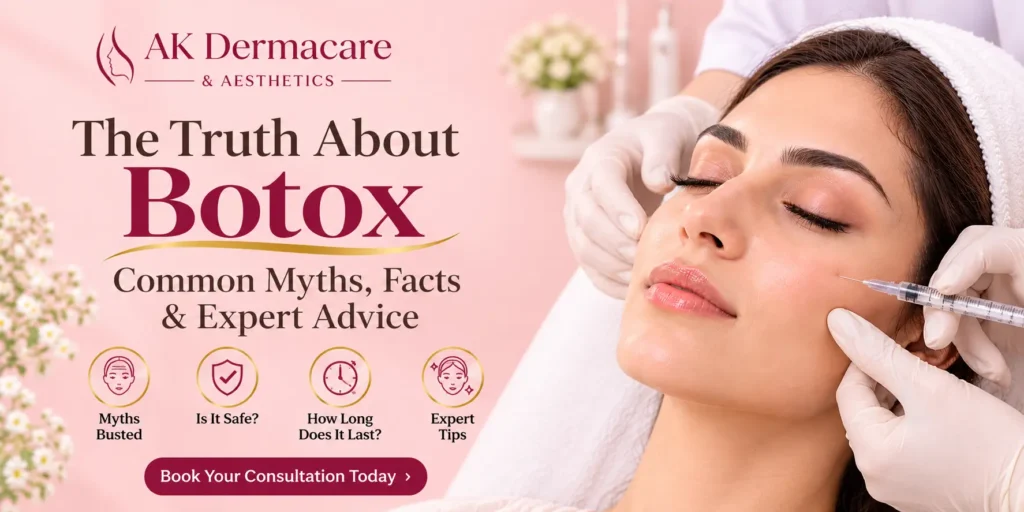
Botox is one of the most researched cosmetic treatments in the world, yet it remains surrounded by myths: that it freezes the face, that it is only for older people, that it is toxic, or that stopping it makes wrinkles worse. In reality, Botox (botulinum toxin type A) temporarily relaxes selected muscles, softening the lines those muscles create. Used in small, well-placed doses by a trained dermatologist, it gives natural-looking results that last around 3 to 4 months. The outcome depends far more on diagnosis, dosing and injection technique than on the product name. At AK Dermacare in West Delhi, Dr. Parul Garg assesses your facial anatomy, muscle strength and goals before recommending any dose, because the right amount for one face can look stiff or uneven on another.
Key Takeaways
What does Botox actually do? It blocks the signal between nerve and muscle in the injected area, so the muscle relaxes and the overlying lines soften.
Will I look frozen? Not when the dose is conservative and tailored. Overdone, “frozen” results are usually a matter of technique and dosing, not the treatment itself.
How long does it last? Typically 3 to 4 months, sometimes up to 5 or 6 with regular use.
Is it safe? Generally yes, for healthy adults when administered by a qualified doctor using genuine, properly stored products.
Is it permanent? No. The effect wears off gradually, and muscle function returns to normal.
Introduction
Few cosmetic treatments attract as many opinions as Botox. Some people picture a stiff, expressionless face. Others assume it is only for people in their fifties, or that it is somehow dangerous because it comes from a toxin. Social media adds to the confusion, with dramatic before-and-after photos and casual claims about “preventing” ageing.
The truth is more measured and more useful. Botox Treatment in West Delhi is a medical treatment with a long safety record, a clear mechanism and real limits. It can do a lot for the right person and very little for the wrong concern. This guide separates myth from fact, explains what to expect and offers practical advice on getting a result that still looks like you.
What Is Botox and How Does It Work?
Botox is a purified form of botulinum toxin type A, used in tiny, controlled doses. Muscles contract when nerves release a chemical messenger called acetylcholine. Botulinum toxin blocks that release at the nerve ending, so the muscle receives a weaker signal and relaxes.
For cosmetic use, this matters because many lines on the upper face, such as frown lines, forehead lines and crow’s feet, are dynamic wrinkles. They form because of repeated muscle movement. When the muscle softens, the skin above it smooths out and stops creasing as deeply. Over time, less repeated folding may also help lines from etching in further.
Botox is not a filler. It does not add volume, and it does not tighten sagging skin. Lines that are visible at rest because of lost collagen, or hollowing due to volume loss, need different treatments. Matching the tool to the concern is the first mark of good practice.
Common Myths and Medical Facts
Myth 1: “Botox freezes your face.”
Fact: A frozen look results from too much product or poor placement, not from Botox itself. A skilled injector uses small doses in specific muscles and leaves others active so expressions still look natural. Many patients want to keep some movement, and dosing can be adjusted to allow that.
Myth 2: “Botox is poison, so it is dangerous.”
Fact: Botulinum toxin is indeed toxic at very high doses, which is why it is only used in microscopic amounts under medical control. The doses used for cosmetic purposes are extremely small and localised. The treatment has been used for decades in ophthalmology, neurology and dermatology, and its safety profile in trained hands is well documented.
Myth 3: “Botox is only for older people.”
Fact: Age is less relevant than the pattern of lines and how strongly you use your muscles. Some people in their late twenties or thirties with deep expression lines benefit from small doses, while others in their fifties prefer other approaches. There is no universal starting age, and the decision should be based on your face, not a number.
Myth 4: “Once you start, you can never stop.”
Fact: Botox is not addictive, and stopping does not make your skin worse than it would have been. When the effect wears off, the muscles return to their previous strength and lines return to where they would naturally have been. Some people feel they look older after stopping, but this is a contrast effect, not damage.
Myth 5: “Botox makes muscles weak or saggy permanently.”
Fact: The effect is temporary and reversible. Muscles that are not used for a long time can become slightly thinner, which some people find beneficial, for example in the jaw or calves, but function returns after the toxin wears off.
Myth 6: “It is a painful procedure.”
Fact: Botox is injected with very fine needles and most people describe brief pinpricks. Numbing cream or cooling can make it more comfortable. The session itself usually takes 10 to 20 minutes.
Myth 7: “Botox and fillers are the same thing.”
Fact: They do entirely different jobs. Botox relaxes muscles to soften movement lines. Fillers add volume or contour to areas like cheeks, lips or under the eyes. They are often combined, but neither replaces the other.
Myth 8: “Botox results are instant.”
Fact: Effects begin gradually, typically after 3 to 5 days, and reach full effect at around 10 to 14 days. Expecting to see a difference the same day, or panicking at day two, is a common mistake.
Myth 9: “Cheaper Botox is the same as expensive Botox.”
Fact: Price differences can reflect product authenticity, the doctor’s experience and clinic standards. Diluted, counterfeit or improperly stored product can produce weak results or complications. Always ask to see the vial and confirm the brand and batch.
Myth 10: “Botox is just for wrinkles.”
Fact: Botulinum toxin has many medical uses, including excessive sweating (hyperhidrosis), migraines, teeth grinding (bruxism), certain eye and muscle disorders, and jaw slimming in selected cases. In aesthetics, it is also used for softening a “gummy smile,” lifting the brow subtly or relaxing neck bands.
Where Botox Is Commonly Used
| Area | What it treats | Points to know |
| Forehead lines | Horizontal lines when raising eyebrows | Needs careful dosing to avoid a heavy brow |
| Frown lines (glabella) | Vertical “11” lines between the brows | Often the first area treated |
| Crow’s feet | Lines at the outer corners of the eyes | Softens the lines when smiling |
| Brow lift | Subtle brow shaping | Depends on muscle balance |
| Jawline (masseter) | Square jaw, teeth grinding | Takes weeks to show, may need repeat sessions |
| Gummy smile | Excess gum on smiling | Small doses, precise placement |
| Neck bands | Vertical bands in the neck | Best in selected patients |
| Underarms and palms | Excess sweating | Effect can last longer than cosmetic areas |
Who Is a Good Candidate?
Botox tends to suit:
- Adults with dynamic lines that appear with expression
- People who want a subtle refresh rather than a dramatic change
- Those with strong muscle activity, such as a heavy frown or jaw clenching
- Individuals who understand it is temporary and are comfortable with maintenance
It is less suitable, or needs a different approach, for:
- Deep static lines at rest caused by volume loss or sagging
- Significant skin laxity, which may need energy-based or surgical treatments
- Unrealistic expectations, such as a complete change of facial structure
Who Should Avoid or Postpone Botox
Your dermatologist may advise against Botox if you:
- Are pregnant or breastfeeding
- Have a neuromuscular condition such as myasthenia gravis or similar disorders
- Are allergic to any component of the product
- Have an active skin infection at the injection site
- Are taking certain medications that affect neuromuscular transmission, including some antibiotics, which should be discussed
- Have unrealistic expectations or are seeking treatment under pressure
Tell your doctor about all medicines, supplements and previous cosmetic treatments before starting.
What Happens During a Botox Session
- Consultation. Your dermatologist studies your face at rest and in movement, discusses goals and explains what is realistic.
- Mapping. Injection points are chosen according to your muscle pattern, not a fixed template.
- Preparation. The skin is cleaned, and numbing or cooling may be used.
- Injections. Tiny amounts are placed in targeted muscles with fine needles.
- Aftercare. You are given instructions and can usually return to normal activities.
Aftercare: What to Do and Avoid
- Do not rub or massage the treated area for the first day
- Stay upright for about four hours after treatment
- Avoid intense exercise, saunas and heat for 24 hours
- Skip facials, laser or pressure on the area for a few days unless advised
- Keep making gentle facial movements as instructed, as your doctor may suggest
- Avoid heavy alcohol on the day of treatment to reduce bruising
Small bumps at injection sites usually settle within an hour or so, and any redness or tiny bruises fade quickly.
Timeline: What to Expect
| Stage | What you may notice |
| First few hours | Small bumps, mild redness at injection points |
| Days 3 to 5 | Movement starts to soften |
| Days 10 to 14 | Full effect, this is when to assess and adjust |
| Months 3 to 4 | Movement gradually returns |
| Ongoing | Repeat sessions to maintain results |
Many dermatologists like to review patients at around two weeks to check the balance and top up if needed. With regular treatment, some people find they need fewer units over time, though this varies.
Risks and Side Effects
Botox is generally well tolerated. Common and mild effects include:
- Tenderness, redness or small bruises at injection sites
- Mild headache in the first day
- Temporary tightness or a feeling of heaviness
Less common effects, mostly related to technique or product spread, include:
- Eyelid or brow drooping (ptosis): Occurs if the toxin diffuses to unintended muscles, and usually resolves over weeks
- Asymmetry: An uneven brow or smile, which can often be corrected with fine adjustment
- Dry eyes or eyelid changes in some cases
- Allergic reaction, which is rare
Serious complications are uncommon when treatment is done by an experienced doctor with genuine product. Most unwanted effects are temporary because the toxin itself wears off.
Why Results Sometimes Disappoint
When Botox does not deliver, the reasons are usually practical:
- Wrong concern. It was used for volume loss or sagging that it cannot fix.
- Under-dosing. Too little product for strong muscles gives a weak, short-lived result.
- Poor placement. Injecting the wrong muscle leaves lines untouched or creates asymmetry.
- Counterfeit or diluted product. Cheap clinics may cut corners.
- Poor storage or reconstitution. These reduce potency.
- Unrealistic expectations. Hoping Botox will lift, tighten or smooth all skin texture.
- Rare resistance. Very occasionally, the body produces antibodies against the toxin after frequent, high-dose use.
Botox vs Fillers vs Other Options
| Treatment | Best for | Points to consider |
| Botox | Movement lines on the upper face | Temporary, needs repeat sessions |
| Dermal fillers | Volume loss, contour, deep folds | Different risks, can last 6 to 18 months |
| Laser and resurfacing | Texture, pigmentation, fine lines | Needs downtime and sun care |
| Microneedling and PRP | Texture and skin quality | Gradual improvements |
| Threads and energy devices | Mild laxity | Suitable for selected cases |
Many patients benefit from a combination, but the order and combination should follow a plan.
Tips for Natural-Looking Results
- Start with a conservative dose and top up later
- Keep some movement instead of aiming for zero movement
- Choose a doctor who assesses your whole face, not just the line you point to
- Ask to see before and after photos of the doctor’s own patients
- Avoid comparing your result with filtered social media images
- Follow aftercare carefully and attend the review visit
- Space repeat sessions sensibly rather than chasing the effect week to week
How to Choose a Clinic
Before booking, consider these questions:
- Is the person injecting a qualified doctor trained in facial anatomy?
- Is the product genuine, from a recognised brand, and can I see the packaging?
- Will there be a proper consultation before treatment?
- Is the clinic transparent about dosing, price per unit or per area and follow-up?
- Are risks discussed honestly?
Be cautious of clinics that offer heavily discounted deals, pressure you into bigger packages or promise dramatic, guaranteed results.
Final Thoughts
Botox is neither a miracle nor a danger. It is a well-studied, reversible treatment that does one thing very well: relaxing specific muscles to soften expression lines. When the dose is conservative, the injector is skilled and the concern is right for the treatment, the result is a fresher, calmer look that still resembles you. When it is used for the wrong problem, or by someone without adequate training or genuine product, the results can disappoint or look unnatural.
At AK Dermacare in West Delhi, Dr. Parul Garg assesses your facial anatomy, expression patterns and goals before recommending dosing, and explains clearly what Botox can and cannot do. If you are curious about Botox, a consultation is the best way to replace myths with facts and to decide whether it fits your needs.
Frequently Asked Questions (FAQs)
1. Will Botox make my face look frozen?
Not if it is dosed conservatively and placed accurately. A frozen look usually comes from too much product or poor technique. A tailored plan can soften lines while keeping natural expression.
2. How long does Botox last?
Most people see results for about 3 to 4 months. With repeated treatment, some find the effect lasts a little longer, though this varies from person to person.
3. At what age should I start Botox?
There is no fixed age. It depends on your line pattern and muscle activity. Some people benefit in their thirties, while others do not need it until later or prefer different treatments.
4. Is Botox safe?
For healthy adults, it is considered safe when given by a trained doctor using genuine product. Side effects are usually mild and temporary, and serious complications are rare.
5. What happens if I stop Botox?
The muscles gradually regain movement and lines return to where they would have been naturally. There is no evidence that stopping makes your skin worse than before.
6. Can Botox be combined with fillers or other treatments?
Yes. Botox is often combined with fillers, skin boosters or resurfacing treatments, with the sequence planned by your dermatologist for best results.
7. Who should not have Botox?
People who are pregnant or breastfeeding, have certain neuromuscular conditions, are allergic to the product or have an active infection at the site should avoid or postpone it. Your doctor will review your history first.